Author: cancerartscinetwork
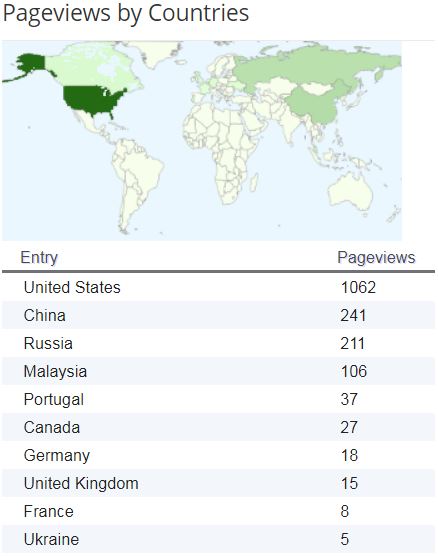
NYC dream: To my readers from 10 countries
NYC dream: The pipette and the paintbrush
My vision for the third goal was to bring art to the scientific research labs as a way to fill the blind spot in data-driven research – to help scientists understand complex theoretical concepts of cancer where real-life data are not available yet. The major hurdle was to avoid the vicious cycle. Some of the cancer researchers and science writers told me they would consider believing that art can help advance science if I could show them evidence of others reporting so. One way to overcome this was through the documenting evidences through the Art and Cancer section of Leonardo journal from MIT Press. Thankfully, Leonardo’s editor-in-chief who was also a NASA astrophysicist believed in my vision.
Now, I cannot speak for other cancer researchers who dived into practicing art and found benefits in their scientific research. I understand it takes courage to break an ideology as a set of beliefs that art is way too loose to help data-driven, reproducible, statistically significant, evidence based scientific research. Moreover, the value of fighting this battle is not clear to most of the cancer researchers.
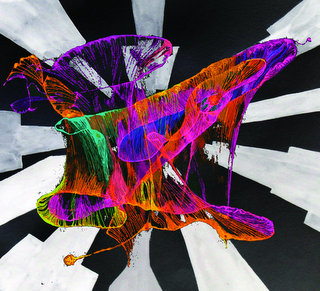
But, I can speak for myself. In early 2016, when my scientific article undergoing review at the Cancer Research journal from AACR Press demanded some in vivo data, I utilized that situation as an opportunity to use art and science together to answer a complex question.
![]() |
| My visual exploration of cancer as a chaotic system |
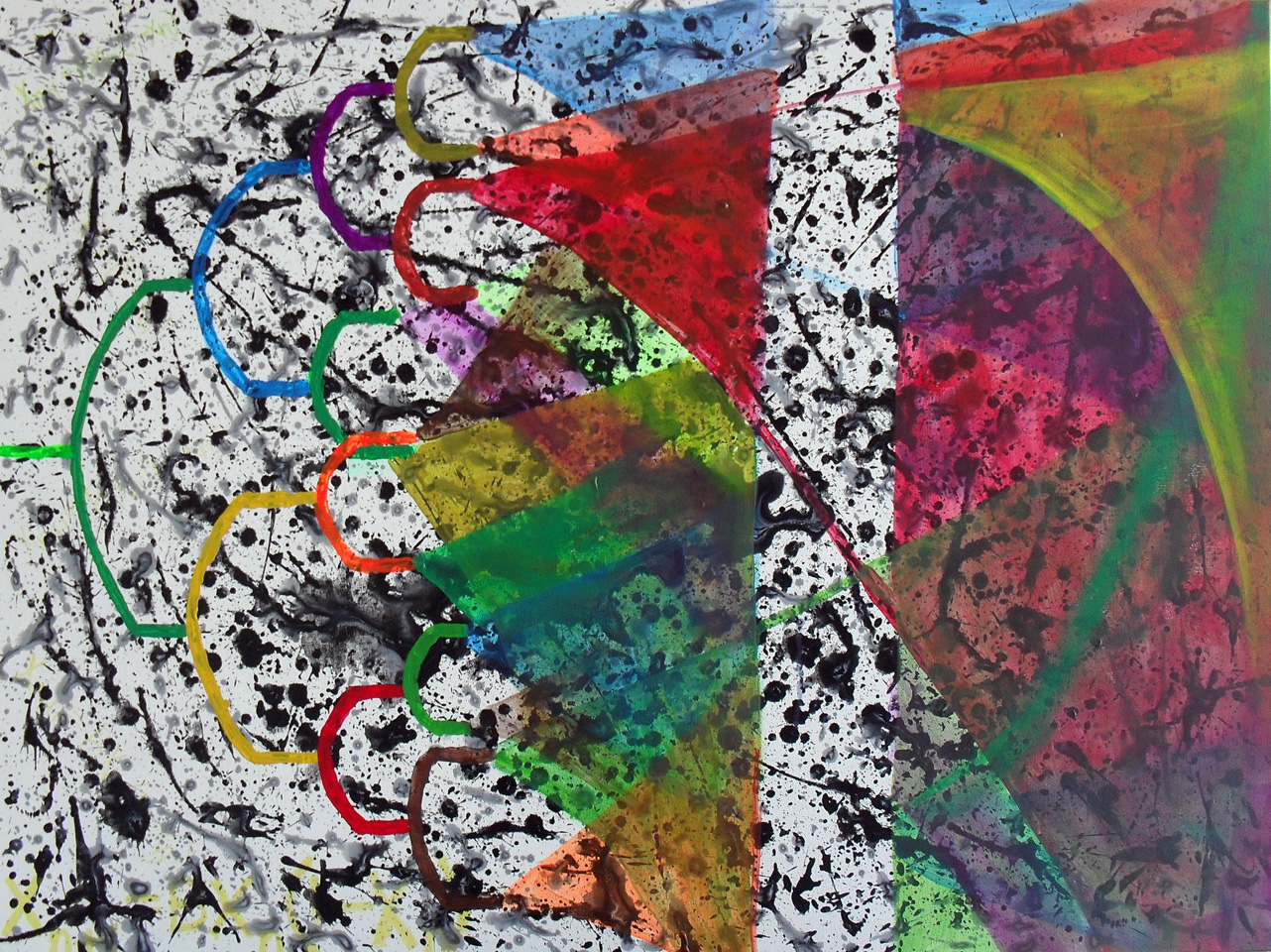
The second question was trickier. For this one, I studied concept called the “period of intermittency.” Now, in terms of time scale, the period of intermittency is a short period and the tumors can go back being chaotic or unpredictable with a slight increase in growth signal from within the cells or from the microenvironment. Ideally, I wanted to space out the schedule in a way to keep the tumors in the intermittent state at my best efforts. This led to the thought – “how to space out the doses.” This was the artistic intuition part of the process. This is somewhat a balance between how much drug we give to eliminate the cells and how much growth promoting signals the cells are receiving. I was very happy when I observed that my experiment on reducing the growth of lung tumors in animals gave a positive result.
![]() |
| My painting on the period of intermittency in tumor’s evolution |
NYC Dream: Adaptation, transformation and genesis
![]() |
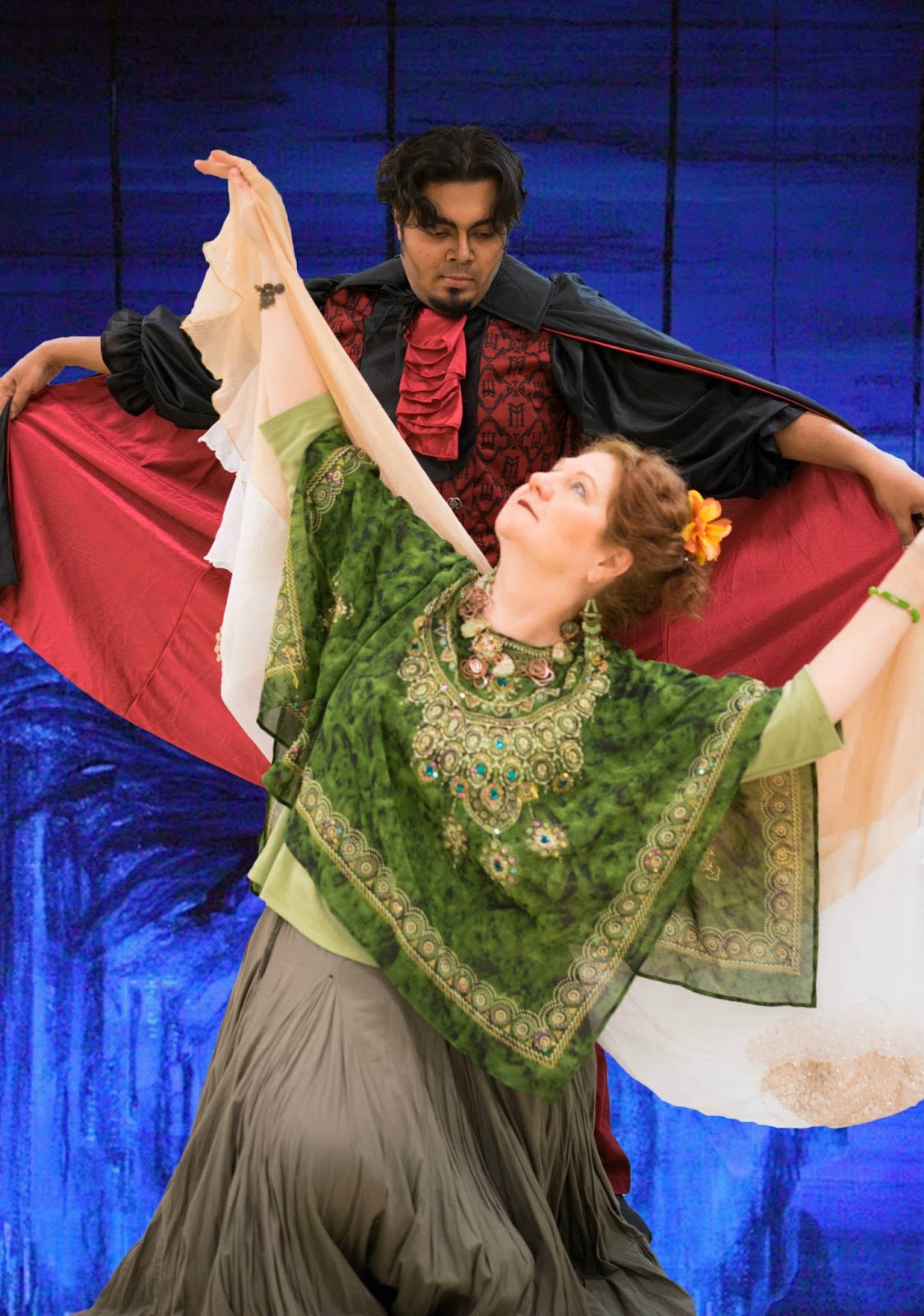
| The Indian choreographic adaptation of a short segment of Swan Lake at the Art Institute of Dallas. |
In Dr. Anne Perry’s Transformation and Adaptation class at the Art Institute of Dallas, I did my final project on three layers of adaptation of Swan Lake. The original Bolshoi ballet Swan Lake inspired Aronofsky’s Black Swan as well as Matthew Bourne’s ballet version. Interestingly, the adaptation of Swan Lake in Stephen Daldry’s 2000 film Billy Elliot was tightly connected with Bourne’s ballet version as Adam Cooper, the principal ballet dancer played 25 year old Billy Elliot in the film.
![]() |
| My medieval style painting was inspired by Swan Lake and Darren Aronofsky’s 2010 film Black Swan. |
Finally, there were my paintings and choreography of a short segment of Swan Lake shown and performed at the Art Institute of Dallas.
![]() |
| My mixed media piece |
Two years later, as I was reflecting on my own life, I realized adaptation evolves over time as we blend in our own experiences with our inspirations. As a result, I combined my earlier sketches on Swan Lake with my personal performance in playing the evil wizard Rothbert. The struggle of emulating the characters combined with fights in my own life, with a little help from gravity created a fluid, biomorphic and somewhat psychedelic mixed media piece with dynamic composition.
NYC dream: Connecting four artists from four corners of the world
This is a tale of three girls and one boy separated by time and space and how they teamed up because of their common passion and experience in inspiring the audience to tell their own stories via art.
![]() |
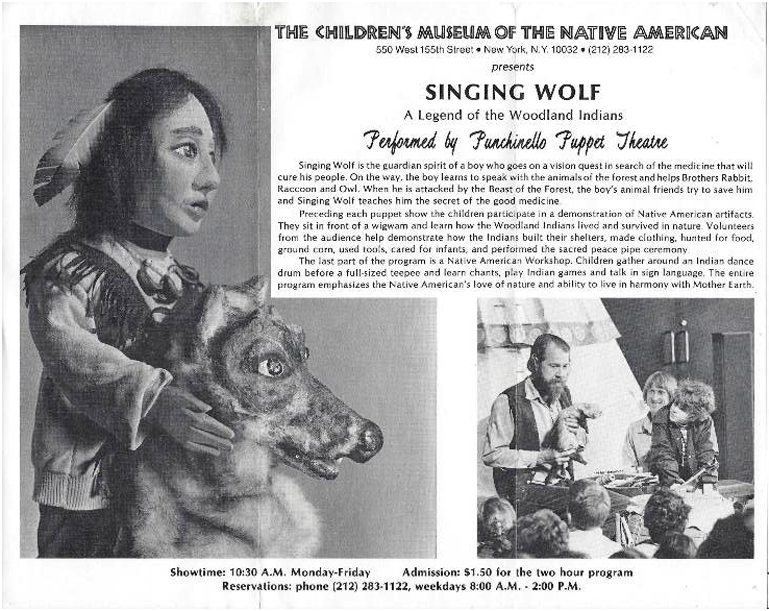
| Figure 1: Puppet show designed by Elisabeth Schalij at the Museum of American Indian in New York City where children interacted with the puppets created by Elisabeth as a mode of art communication. |
Back in 1930s, Netherlands, Elisabeth was growing up with a dream of telling stories like that of Grimm and Anderson. Her fascination with the symbolic meaning and similarities of mythologies made her travel across the seven seas like Sinbad and to reach New York City, USA. After establishing herself as a renowned international artist, she created hundreds of thousands of art shows and workshops all around the world. The most impactful of them was a puppet show at the Children’s museum and Hudson River Museum, New York (Figure 1). With a focus on Native American stories, the puppet show inspired many including the 4th Grade students of Midland School, New York. Cornelia Mason, the 4th grade teacher recalls “How great it was to have the puppet show and especially great (and educational I might add) to have it coordinated with the subject of Indians.” On Elisabeth’s recent book “Snowbear”, a story and illustration of Inuit folklore, Jaap J. Bredee, professor emeritus of Utrecht University, Netherlands writes “I could envision Snowbear to become another classic story about the American Indians, who were treated so terribly in the past.”
![]() |
| Figure 2: Caroline Shaw Ometz teaching her workshop at Mendocino, California in 2013 and inspiring her students to create their own stories, exploration and questions on life in painting. |
In the meantime, as a little girl, Caroline, in 1950’s southern United States always dreamt of teaching art in a way that her students realize their natural creativity. Turning her dreams into reality, a miracle itself in her life, she taught for past 40 years in Creative Arts Center, Craft Guild, Plano Recreation center and Continental Gin Building, Dallas. Building on her own Graduate level training at SMU, UTD and University of Dallas, she provided a nurturing environment for her students to meet their individual creative need. Her most impactful teaching experience is at the Mendocino Art Center, California (Figure 2). Her student, Anne Neal, currently a sculptor herself, recalls “Caroline’s teaching has changed the way I relate to and practice art. From Caroline, I learnt to step away from focusing on techniques and instead focus on the message. I now see space as an opportunity for a fluid dialogue instead of something empty waiting to be filled.” Similarly, Roberto Munguia, Cistercian Preparatory School/ Art Department Head says “Caroline has been a real source of inspiration to our students. She has been able to facilitate their making a deeper connection with their work and to reach beyond technical proficiency towards personal inner vision.”
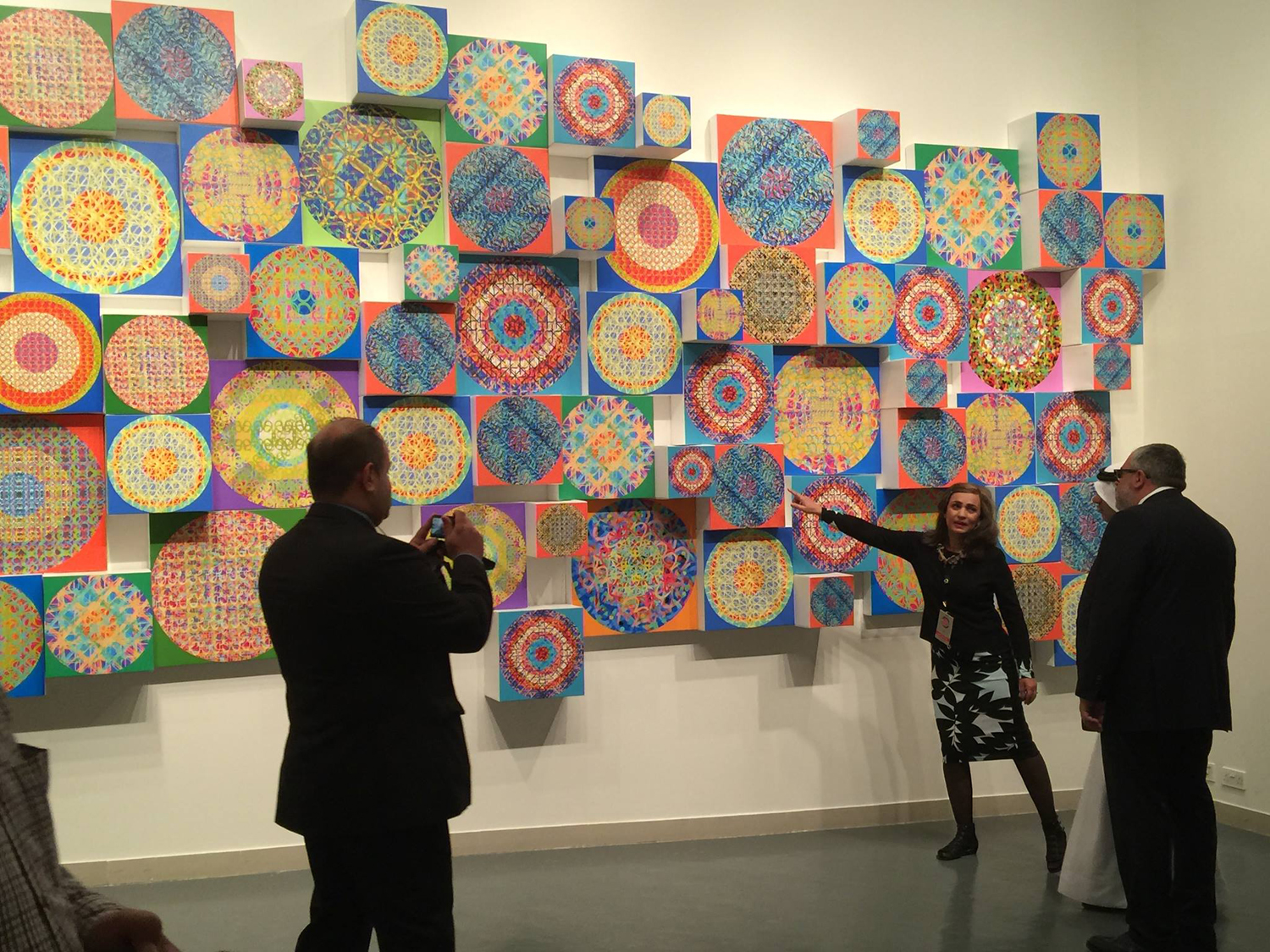
8000 miles away from Caroline, was Shafaq. Born in Rawalpindi, Pakistan, Shafaq has always been drawn to mysticism. She lived in United Kingdom, Iran and Denmark before fully realizing her artistic purpose and settling down in United States. Over past few decades she wore and switched several hats: a BFA student of Virginia Commonwealth University, Richmond, an MFA student of Texas Christian University, Fort Worth, a glass artist collaborating with galleries in Czech Republic and Sweden, and a multimedia artist with many solo and 70 group exhibitions all around the world. Her most impactful work involving interaction with audience and inspiring them was with the Minister of Art and Education at Sharjah, United Arab Emirates (Figure 3). Her work in connecting the contemporary calligraphy presenting mysterious letters, realm of hidden geometric and fractal patterns impacted the audience to create their own form of art and shaped the future of art educational programs in United Arab Emirates. Recently, Deborah Fleck from Dallas Morning News writes about her solo exhibition – “For big, bold and colorful see the paintings of Shafaq Ahmad.”
Born in 1980’s Kolkata, India, Dhru had a dream of merging art and science. Just like the North East Indian folklore of “Grandmother’s tales” he flew over thirteen rivers and seven mountains to reach Dallas, Texas. His PhD studies in biomedical science At UT Southwestern Medical Center, Dallas and BA studies in visual art at University of Hertfordshire, UK, enabled him to communicate complex problems of science via art to a broader audience and to be involved in transforming the education in both elementary (The Hockaday School) and higher level (Center for Art and Technology, UTD). The most impactful of his interactions was at the LuminArte Gallery, Dallas (Figure 4), where he curated and participated in an art show with 50 artworks from 6 artists and scientists and a panel discussion with 2 scientists and 2 artists. This educational event enabled an exchange of knowledge and inspiration to create art of science among 140 audience members. Priscilla Di Thiene, Editor of Le Scienze from Rome recalls “Our magazine deals with a lot of scientific arguments. But, your images published in Le Scienze show such a different way to see, study, understand and approach cancer.”
![]() |
| Figure 5: Example of 4 paintings from 4 artists |
In 2016, Dallas, these four artists teamed up realizing their common interest in telling magical stories from around the world and in the process inspiring their audience to share their own stories in visual and literary art. Just like the magical objects in their stories, they plan to utilize paintings, sculptures and storytelling in their workshops to bring out the magical creativity in their audience. Elisabeth’s paintings and story “Markel the Magnificent” (Figure 5, top left) shows how each audience as an individual has the magical ability to bring someone back to life. Caroline’s visuals and writing on “God Quest” (Figure 5, top right) encourages creative thinking and imagination of the audience in finding their inner peace. Shafaq’s paintings and sculptures on “Conference of birds” (Figure 5, bottom right) inspires deep thinking, compassion and will lift the spirit of the audience in pursuing their own creative art form. Dhru’s paintings and story “The gold wand and the silver wand” (Figure 5, bottom left) establishes the audience as heroes who look for ways and means to overcome demon-like diseases in their own lives and in the process shares their own story in visual and literary art. Together these four artists from four corners of the world show the audience that no matter where they are from and where they are now in life, everyone has a story worth telling and if we don’t tell our stories, no one else will.
NYC Dream: Staycation and apartment therapy
![]() |
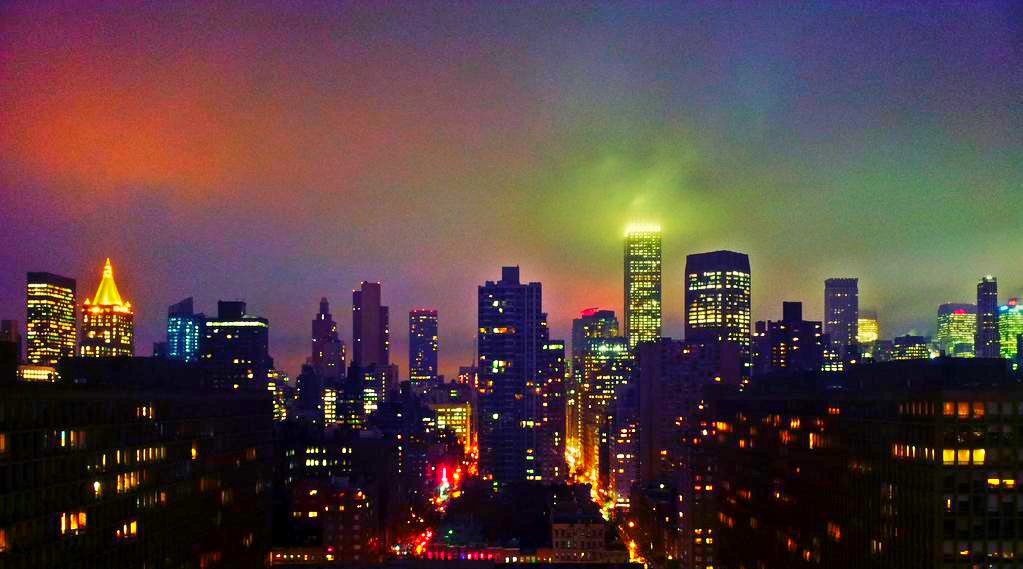
| A photo I took on a cloudy night from a high rise at Kips Bay looking down at 33 and 34 St. |
![]() |
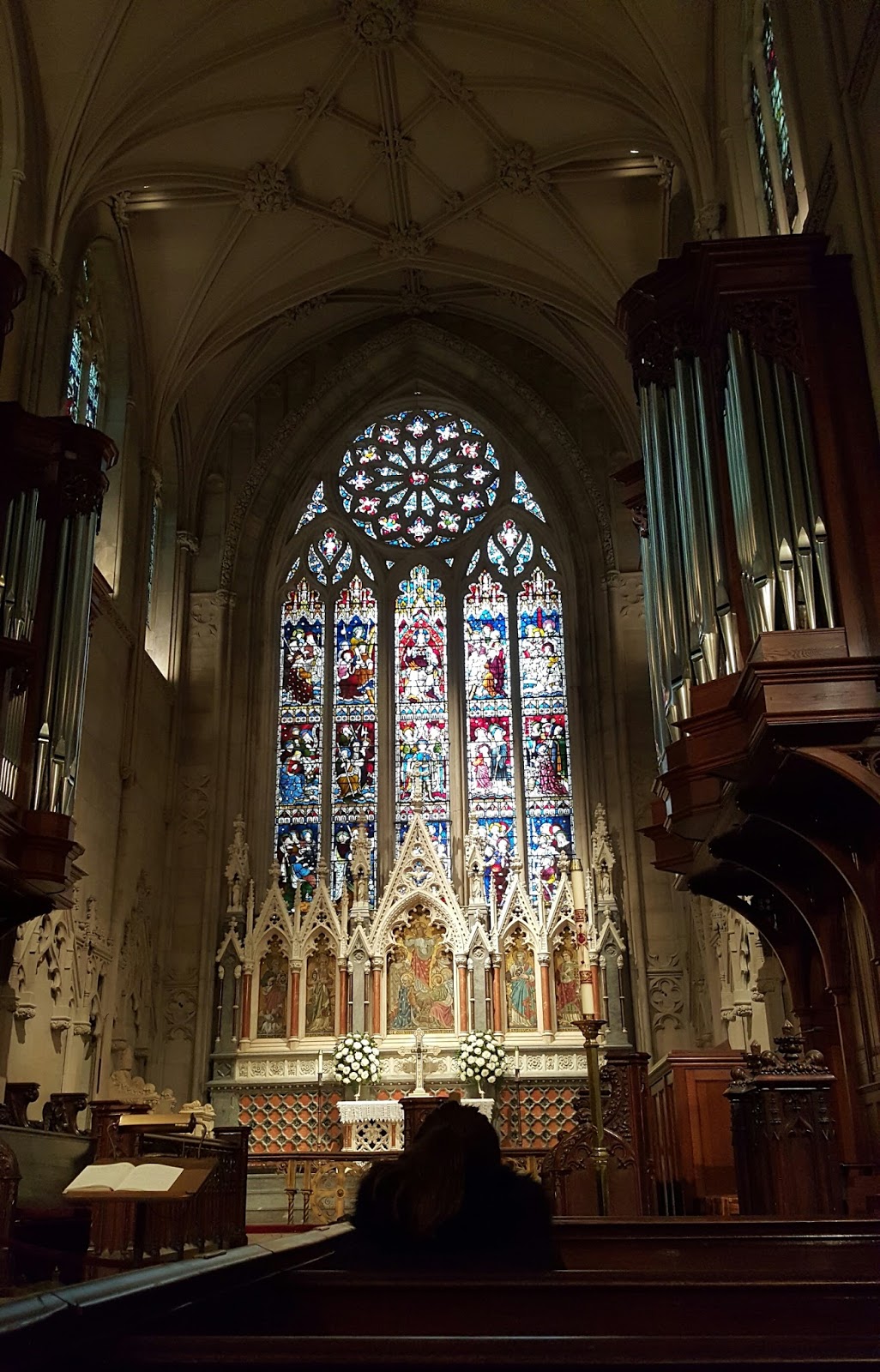
| The Basilica of St. Patrick’s Old Cathedral |
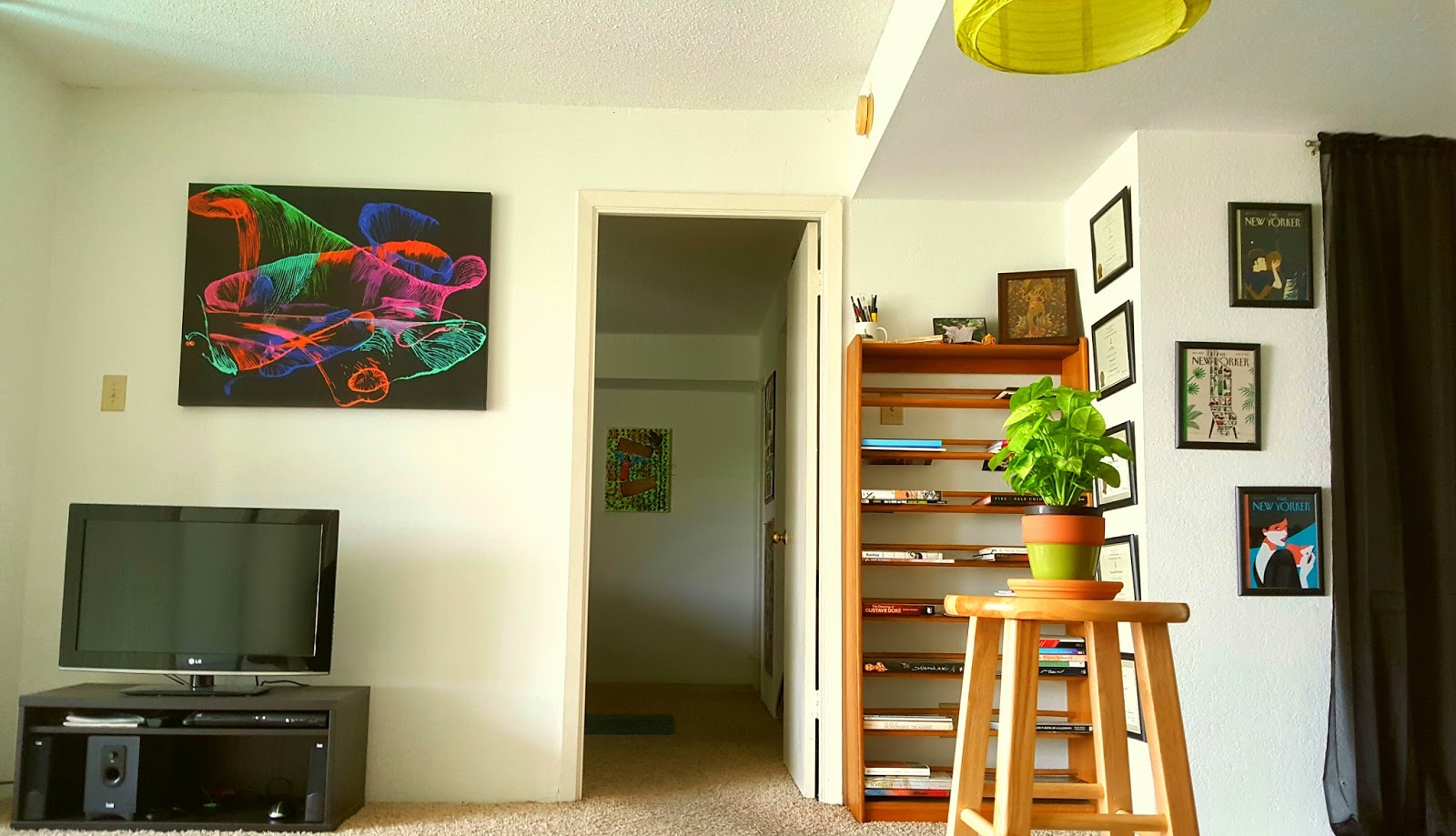
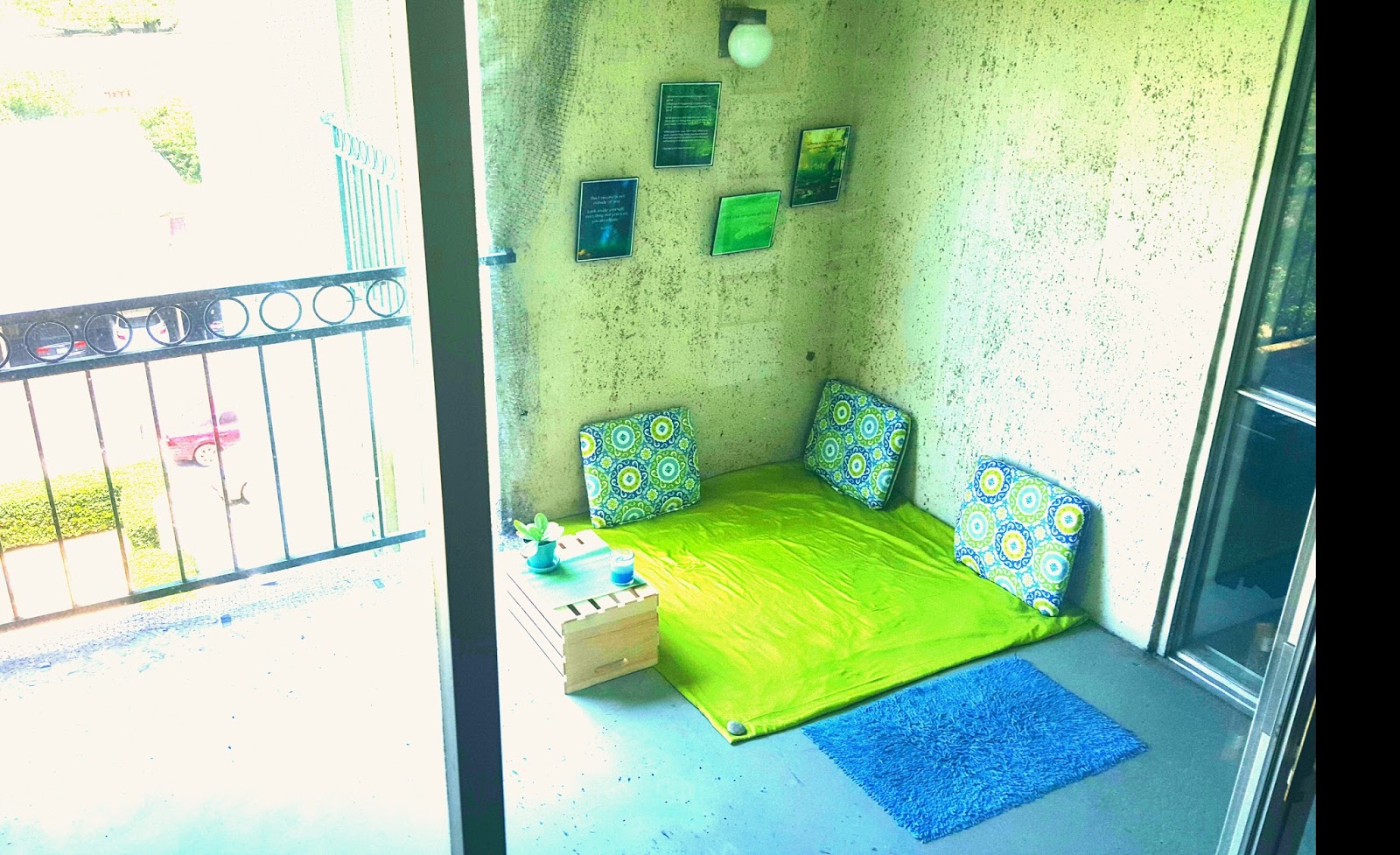
I was very happy with the Industrial city look accented by the NYC subway rug and custom built pillow covers. I am attracted to the NYC skyline or the bird’s eye view at night which is printed in greyish blue colors on two of the pillows. For the middle one, I wanted a bit of contrast. Instead of using more images on the print, this time I went with typography. In this pillow cover, each landmark of NYC is written with a typeface mostly associated with it. For example, the word “Broadway” is written with the Broadway typeface. The subway rug would only make sense to people who like me can connect the symbols of each of the subway lines in the city.Finally created a Zen nook to relax and meditate in my patio! In the morning, I could use this space to read those books I collected. In the evening I could enjoy a drink or two. Now this is a lot larger than a typical 35 square feet NYC patio. But, I needed a little escape to calm down my mind. I used the colors I am drawn to (shades of green and blue) and a small succulent (flowering plants are way too high maintenance and do not fit my lifestyle). I hanged some of the quotes from spiritual leaders from many religions that help to calm me down.
I believe by doing this exercise of bringing NYC close to me, I finally realized the saying by Rumi – “This universe is not outside of you. Look inside yourself; everything you want you already are.” While dealing with my obsession of living in NYC for past couple of years, I didn’t notice when I turned into a New Yorker at heart and wherever I go people notice that New Yorker vibe in me!
NYC Dream: The charging bull vs. the fearless girl
The Fearless girl sculpture by Kristen Visbal in Wall Street indeed drew a lot of media attention. The placement of Fearless girl in front of the Charging bull by Arturo Di Modica was extremely strategic! As the charging bull represents financial power of Wall Street (or capitalism in America) in influencing world-level decisions, the fearless girl can be studied as an icon of millennials taking a stand against “life-long debt” imposed on individuals in a capitalist country. On the other hand the impact is further augmented by placing a girl’s sculpture instead of that of a boy. The story of David and Goliath is pretty famous. But “Diana and Goliath” was cleverly timely with the Wonder Woman film doing so well in the box office!
NYC Dream: the obsession, the dilemma and the truth
As a big compensation I curated and participated in a cancer based art show bringing in 6 artists and cancer researchers in one of the top 5 galleries in the Design District of Dallas and installed 35 pieces of artworks worth $1.5 million. My cancer researcher boss kindly served as one of the four panelists along with visionaries and famous scholars from the field of astrophysics, art therapy, business and spirituality. More importantly, my scientist boss’ artist sister flew in from San Diego to watch this show. The evening I moderated this panel discussion, I received the best reward of my life. Both my lung cancer and art mentors exclaimed in union to 140 audience members (and to my embarrassment) “I wish all my students were like Dhru!” That was just the beginning.The editor-in-chief of Leonardo, the second best visual art journal according to Google h5 index, agreed to create a special section named “Art and Cancer” on my request. I paid off by serving as the section editor and creating an editorial advisory board inspiring and enlisting a senior editor from prestigious Science magazine. In April of this year, Leonardo published their top 2 articles on art and cancer and I wrote the very first editorial of my life!
NYC dream: How to study Art History
NYC dream: Being a Paradisciplinary Sci- Artist
Leonardo Da Vinci epitomizes the boldness of the Renaissance, when the confidence in the capabilities of man led to the idea that they could excel in many activities. Born in 1452, Leonardo was trained in Florence, and he was very much the product of the cultural and artistic environment of that city. He worked for the court of the Medici family there. Later for many years in Milan for the ruler of the city, Ludovico Sforza, he worked as an artist and as a military engineer. At the end of his life he was called to France by king Francis I. He died during 1519 (5, 6).
His interest in art and science were linked to each other, like two sides of the same coin. Figure 1 shows a drawing by Leonardo. It shows studies of the way water behaves when interrupted by foreign object and, at the bottom of the image, when falling from some height on to a pool. Here, the intention of the artist is not to draw a snapshot of a beautiful thing, it is to understand the way the current of water behaves. His tool for doing this is drawing. Interestingly, at that time fractals (self repeating units) were not known to the mathematicians. Neither did scientists understand the interaction of order (predictability) and chaos (unpredictability) in a complex system. However, Leonardo’s drawing and his notes clearly shows that he started to understand the behavior of complex systems using flow of water as an example (7).He studied human body as a complex systems and he drew many parts of it. Figure 2 shows his drawing, Vitruvian Man, where the proportion of human body was studied. Even today, artists practicing figure drawing, character designing and animation follow these simple rules of proportions of human body studied by Leonardo. As is the case today, imaging was in the forefront of scientific research at the time, and Leonardo was a leader in this field. Painting was only one of the many activities in which he excelled. We only know approximately thirteen paintings by Leonardo, depending on whether we accept or not a few attributions in them, and several of these paintings are damage or unfinished. In spite of this he was enormously influential (5).
Alfred Lewin Copley was born on June 19, 1910 in Germany. He resided in Dresden until the age of 20. Then he moved from one city to another in Europe staying for short time in each city such as in Berlin, Frankfurt, Heidelberg, and Basel. After he completed his studies at medical school, he moved to New York City to work as a medical practitioner in 1937. At this point, in addition to practicing medicine, he started taking both practice based and theoretical art classes. He became an U.S. citizen in 1943 and mostly resided in New York City till 1952. He spent 2 years in Paris and then finally settled at 50 Central Park West in New York City. He passed away in 1992 (8).
Alfred took up the artist name Alcopley while residing in New York City. He is well known for his abstract expressionist paintings (Figure 4). In 1949 he was one of twenty artists who founded the Eighth Street Club. The group also included Franz Kline, Willem de Kooning and Alcopley’s close friend, the composer Edgard Varèse (12). He participated in the Ninth Street Show in 1952 and had a solo exhibition at the Stedelijk Museum, Amsterdam in 1962 (9) His work is held in the collection of the National Museum of Modern Art, Tokyo (9).
Francois Joseph Lapointe, born in Quebec, Canada is a contemporary polymath. He earned his B.Sc. in Biological Sciences from the University of Montreal in 1988. In 1992, he finished his Ph.D. in Evolutionary Biology from The University of Montreal. His research area includes Phylogenetic Analysis – phylogenomics, Population Genetics – Molecular Ecology, Conservation biology of endangered species, and Biostatistics – mathematical modeling (13). Interestingly, while working as an assistant professor at the university, he enrolled in a Ph.D. in dance program. He choreographed precise movement at each nucleotide in the genome of the dancers so that they could interpret their own DNA. In addition to his thesis submission in 2012, he created a public performance with 30 professional and semi-professional dancers (14).
On a personal communication (15), Francois wrote to me – “To make a long story short about myself, I must admit that is has been a very long and “interesting” journey to become an art scientist (although I doubt it every day). The thing is that when you expect to have a dual career and want to be successful at both, you must work twice as hard, or accept that you’ll have to be less successful than if you were doing only one thing – science OR art – and not two things at once – science AND art. My own opinion on this is that I will never be fully recognized as a bona fide artist. However, what I do as an “artist” cannot be done without my science training, and without having access to a science lab. For me, being an art scientist is not about being a scientist who also can do art, or being an artist who plays with science. It is more like having a split personality. When I do science, I think as a scientist. When I am doing art, I try to think as an artist (this is the difficult part since the scientist is always looking over my shoulder). Foremost, I see my role and that of others like me as that of an intercessor between two worlds, a translator between two languages.
There are certain individuals who are active visionaries and proponents in art-science collaboration fields. They have been of great motivation and help to me. Cynthia Pannucci, the founder and director of Art Science Collaboration Inc, New York, and Dr. Roger Malina, Executive editor of the Leonardo journal, MIT Press, Massachusetts have been of great help in my art-science journey so far. My Ph.D. mentor, Dr. John Minna, the director of Hamon Center of Therapeutic Oncology Research at UT Southwestern Medical Center, Dallas, Texas has been very supportive of my interest and practice in cancer based art. I have also been very fortunate to meet and learn art from excellent artists such as Caroline Shaw Ometz, Denny Doran and Dr. Anne Gordon Perry.