NYC Reality: Attempting a summer without air conditioning after 10 years

It’s 92F outside now. Google weather tells me that it feels like 95F due to humidity. I’m sitting here by the window in my East Village nano-studio and still feeling good about my decision of not installing an air conditioner this summer.

I will come to “why” I chose to do so later. But first, let me explain how this is possible even with global warming and living within a dominant culture of “air conditioning is my life”! The funny part is that ultimately it comes down to strategic changes in our 3 basic needs: food, clothes and shelter.

Food: I’m omnivorous. Well, that’s a lie. I have some sort of allergy to certain preparations of eggplant. I also cannot stand the taste of raw fish in my mouth. But, to live comfortably during lower Manhattan’s summer, I chose to become vegetarian from the fourth week of June to the third week of September. In general, I’ve observed that my body generates a lot more heat when I eat non-vegetarian food. As I’m a lentils-lover through and through, I think I can survive as a vegetarian for 3 months.

Clothes: New York City is all about black skinny jeans and fancy boots. Well, not if I chose to live without air conditioning! So, bye bye skinny jeans and hello harem pants. Growing up in hot and humid climate of Kolkata, I already had a couple of t-shirts with breathable fabric! To add to that, I bought some pants from Thailand that were worn by the fishermen there. Here in US, you can call them yoga pants or harem pants. But, the point is wearing these pants, you can sit anyway you want without looking indecent! You won’t believe how many times I have to remind my shorts-wearing Californian friends to cross their legs!

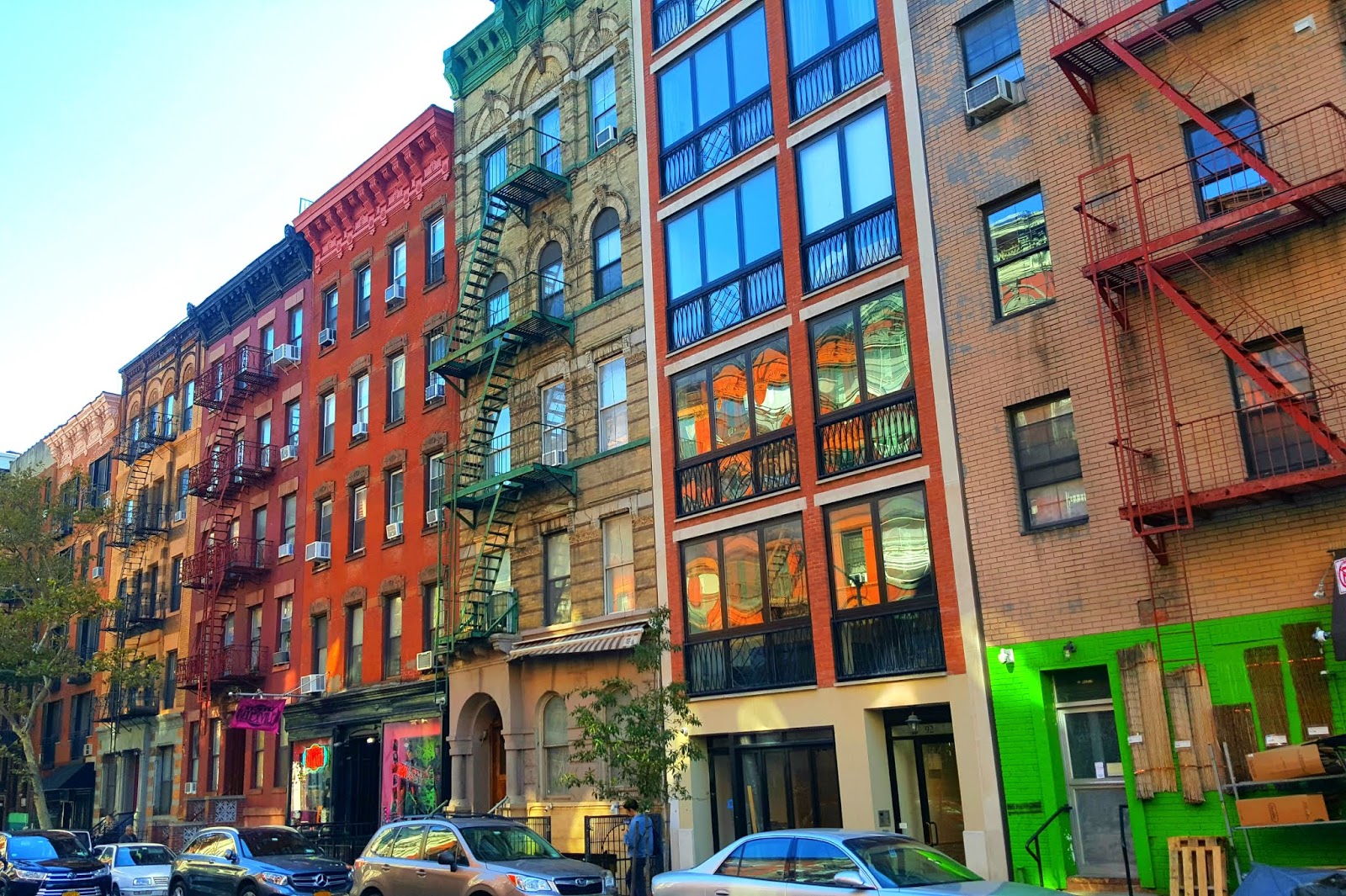
Shelter: High rise with glass walls with plenty of sunlight? Sorry, you must install an air conditioner! Not in my case! This East Village building is approximately 150 years old. So, they have thick, brick walls. I’m on the third floor of this 5 storied building without direct sunlight during the summer as my apartment faces the courtyard. Another plus is that I can keep my window open without the smell of the garbage that the apartments facing the streets deals with during the summer!

Now coming to “why” I chose not to install an air conditioner.

The first part of it is nostalgia. Living in the US for past decade, I never felt so close to the Bengali culture like I feel in New York! Let it be the passer by talking over the phone in Bengali on the streets, the fantastic food of Murray Hill in Manhattan, Jackson Heights in Queens and even Hicksville in the Long Island, I feel at home! And a large part of “feeling at home” is a hot and humid summer! I think I want to embrace that again.

The second part is the practical aspect. I live in a rented, nano-studio with one big window opening towards the fire escape. As the “StreetEasy” ads say, in New York City, the fire escape becomes your second living room during the summer! In this tiny outdoor area, I’m trying to grow herbs like Basil and Oregano, for my insalata caprese  and pesto alla genovese. If I install the air conditioner on the window, my access to this “balcony” will be closed.

In summary, this may sound like a huge deal after living in a centrally air-conditioned apartment for almost 10 years in Dallas! But, for now, cheers to my attempt, with a glass of chilled Rosè!

NYC Reality: facing my most deepest and darkest NYC fear – a mouse!

I knew cooking French keto food in my kitchenette-less lower Manhattan apartment was a bad idea! I thought the smell would invariably attract a “dead” rat on my staircase or a family of roaches in my bathroom. But, no! It turned out that my French cooking brought home the scariest pest of NYC – a mouse!

As I was dealing with some health issues on a very quiet Sunday afternoon, I heard the shuffling noise of plastics from my pantry. It felt like a living thing, a lot larger than a roach, was going through my dry foods. First reaction – I froze. Second reaction – panic fueled with high adrenaline leading to me deliberately hopping in front of my pantry to scare the thing. It worked. A tiny, brown shadow ran from my pantry shelves towards my closet and disappeared under the darkness of the door.

Dear Lord! I have a mouse!

I stood there strategizing my next move. I jumped up and down again and then quickly opened the closet door. Nothing happened. I pulled out the first thing I found – a black pair of jeans and a black shirt (yes, we wear a lot of black here in Manhattan). Then as soon as I was ready, I quickly looked up 5 ways to get rid of mice in NYC apartment on my phone – ultra-sonicator, mint oil, putting all grains and dry foods in hard plastic/metal containers, setting up traps and closing any and all cracks and holes in the apartment.

Easier said than done! After going through pest control isles of Home Depot, Target and Jack’s 99, I could only achieve 4 out of those 5. The ultra-sonicator was a complete fail. The mouse pretty much ignored the peanut butter in the trap and just searched for the bag of very greasy and salty potato chips it chewed through before. Of course, I threw that away the moment I found tiny pieces of plastic from the bag.

As I woke up the next morning, I could remember that I had a nightmare where the mouse jumped on my face trying to eat my eyelids! Feeling exhausted, I reached the lab. Surprisingly, my lab mates’ reactions cheered me up!

Soonhee, the visual researcher, immediately started looking for mouse traps on the internet! Her concern was how to get rid of the mouse alive or dead after it was caught.

Rosa, the Graduate student who turned down an offer from Cambridge to join Columbia, and who very closely reminds me of Phoebe Bouffe from “Friends”, because of her vegetarian diet, straight long hair parted in the middle and a tall, slim figure with a kind face, told me – “I had a mouse once.”

I asked, “Did your cats take care of the mouse?”

Rosa answered – “Dhru, you know me. I closed my bedroom door, shut the cats out and slept in the same room with the mouse to save him from my cats.”

Tetsu, the calmest of them all, a graduate student who just had a paper accepted in PNAS, said very slowly and softly – “You have a mouse? Is it a pet?”

I replied – “I wish! In that case it would be caged and be controlled! Now I’m just worried that it’s going to chew off my passport and visa!” – which invariably led to a discussion of international scientists and the anxiety related to their visa situations.

Zak, the F32-winning postdoc said, matter-of-factly, “Oh yeah, I had a couple of those at some point.”

My mouth fell open “A COUPLE?”

Zak laughed – “Of course! It’s New York! They were going for my almond butter.”

So, in summary, everyone who lived in New York permanently more than I ever have, encountered a mouse situation. This made me feel way better. Perhaps, I will be ok. Perhaps, the mouse will go away on its own if it doesn’t find any food.

I realized, now I truly, undoubtedly and irrevocably understand why they say this about New York – “if you can make it here, you can make it anywhere.”

NYC Reality: Microwave cooking for kitchenette-less New Yorkers

nano apartment kitchenAs a big fan of the film “Julie and Julia” by Nora Ephron based on the book by Julie Powell, I agree with Julie Powell that cooking for people we love exerts a very soothing effect on us. Like Julie and Julia, I like cooking for my family and friends simply out of joy. But, there is one difference. Julie and Julia always had their kitchens. I do not.

As I wrote earlier, when the time came for me to choose between kitchenette vs. private bathroom in a nano-studio of lower Manhattan, I chose the later without hesitation. Most New York City studios have what is called a “kitchenette” at one corner of the room with some cabinet space on top. The kitchenette usually has a dorm refrigerator under a tiny counter top, an oven that can only fit 6 inches by 6 inches baking pans with cooking stoves on top where you can only use one regular sized sauté pan at a time and a sink so small that you can only wash one hand at a time. I do not have that luxury.

When I bought a regular microwave and a dorm refrigerator, I was adamant that I wanted to cook, even though very rarely due to my dish-washing phobia, when my friends and family visited my place for the first time. I took the F train to Jackson Heights in Queens to buy all the Indian rice, lentils, spices, oil etc. I stocked them up in cube organizers placing them on a storage shelf that I received for free. I also bought glass microwavable containers with lid as I never wanted to use plastic ones.

First visit was by cousin Ari and nephew Riaan for dinner. I cooked pulav (rice cooked with ghee, egg, peanuts, and raisins), daal makhani (lentil soup with heavy cream and spices), chicken with tamarind sauce, potato-cauliflower curry and fish with butter, cherry tomato and southern spices. I think it took me 4 hours 30 minutes to cook everything. The chicken was a little overcooked and somewhat dry. I realized I could not follow the usual recipes from stovetop ovens. I must optimize my protocols, like I do in the lab.

However, nephew Riaan liked the food. Cousin Ari texted me later in the evening that Riaan wanted to stay at my place for longer. We also enjoyed the berries cousin Ari brought as dessert.

The second visit was by auntie Cynthia. I wanted to cook Italian because of her Italian ancestry. Auntie Cynthia came with organic red wine and chocolate cream filled pastries. I put out artisan bread with olives and Artiagiano cheese as appetizers. For main course, I made risotto with chowder sauce, chicken alfredo with mushrooms, sour cream and port wine. To keep the flavor of the port from evaporating during microwave, I layered previously whisked eggs on top of the chicken alfredo. The egg acted as a fluffy insulation and held the flavors as the chicken cooked with cream cheese, olive oil, garlic and rosemary.

Auntie Cynthia asked for the chicken alfredo recipe and shared in social media later that week that she might have gained couple of inches on her waistline, but it was worth it!

When auntie Beth visited me for lunch, I already felt like a pro with microwave cooking. Auntie Beth brought a famous olive oil and an interesting Egyptian snack. With a Chilean cabernet sauvignon, they served as the perfect appetizer. I repeated the pulav, daal makhani and chicken curry. But, this time I optimized my protocol for the microwave, finishing the dishes in record time. The chicken was soft and moist. The pulav was al dente. The daal cooked to the extent that it retained its texture but also melted in your mouth.

Auntie Beth, like me, enjoys communicating with metaphors. So, she commented later that week – “Nephew Dhru is a terrific cook. He handles microwave oven like Jose Andres handles a paella pan.”

The irony is that I do not like cooking for myself. But, I had a lot of fun cooking for the people in my life. The moral of the story is – Marie Kondo’ing my life for living in a nano-studio without kitchenette doesn’t mean I could not cook my favorite Indian and Italian foods if I wanted to, as long as the people eating them have an open mind and a big heart.

NYC Reality: My Metropolitan Diary: Neighbors

3 of us, New York apartment dwellers, were describing our neighbors.

One said – my upstairs neighbors, a middle aged couple with 2 teenage kids, host karaoke every other night!
Another said – my upstairs neighbors have 4 toddlers who, at 11 pm, run across the apartment, throw the heaviest book on the floor, jump and then repeat!
Finally, I said – my neighbor is a noise police. He knocks and bangs on everyone’s door if there is a tiny bit of noise.
As everyone looked at me in silence, I added, “I let him do the dirty work and enjoy the peace.”

NYC Reality: Re-defining essentials for living in a nano-studio apartment

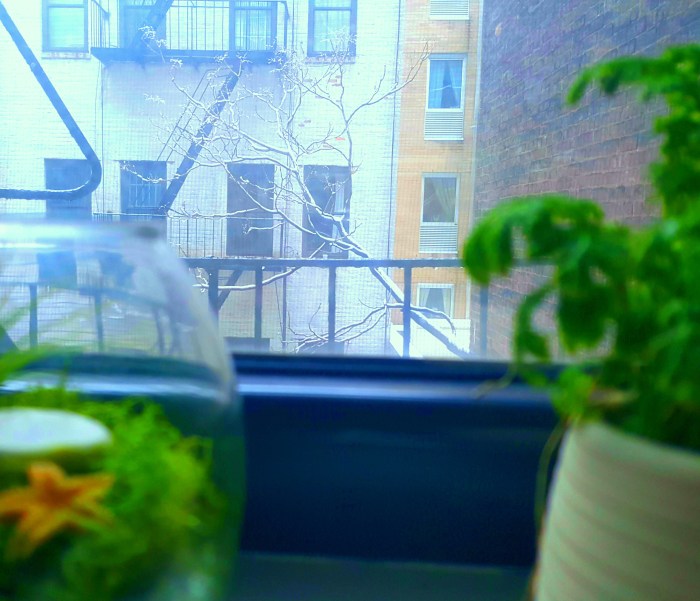
Plants on the windowsilMy plan of moving to New York City began when I started this blog 5 years ago. As I kept an eye on the real estate of the apartments over time, I knew I would live in a small studio apartment for three main reasons: affordability, connectivity and creativity.

But, a lot of thoughts needed to be put into defining and re-defining my essential belongings, both in terms of utility and aesthetics, when I decided to move into a 175 sq. ft. nano-studio in East Village from my 625 sq. ft. one-bedroom apartment in Dallas.

So, I created a set of 6 rules.


Cube divider and chairRule 1: Prioritize essentials based on how much time I spend with each one of them

This is very simple as immediately the bed, the study table and the chair came up on top of the list. Saying goodbye to my 8 year-old, king-size bed back in Dallas and adjusting to a smaller sized study table in the new apartment was not easy. But, the new, small bed by the big window during the winter (and a huge in store discount from the Mattress Firm) calmed me down. The study table was initially a side table that my neighbor was throwing away. I just replaced their short legs by regular ones with a trip to the Ikea in Brooklyn. Instead, of my old, bigger chairs, I switched to a folded chair from Ikea for study purpose.


Bed by the windowRule 2: Every essential must have multiple purposes

The bed, with simple and alternative arrangement of pillows on top, becomes a day bed, if needed to be used for sitting during the day. The study table placed strategically becomes the kitchen counter top when I’m cooking and serves the purpose of a dining table when I pull out the dining stools from underneath it. The study chair wears a furry blanket from Family Dollar and with my New Yorker pillow on top, it adds more sitting places when I’m entertaining friends.


DIY zen terrarium and serving trayRule 3: Books and paintings can be used to further define the space

As my books and paintings are part of my essentials, I used them to further augment the interior design. To bring the eyes up, I hanged the big paintings just 3 ft. below my 14 ft. tall ceiling matching the window height and thus using the tall ceiling as a breathing space in such a tiny studio. One set of books went in one of the cubes of a step-wise 9-cube organizer that also served as my tiny bar with DIY lights in an odd corner (thanks to extension cords from Jack’s 99). The other set was stacked vertically by the side of the bed with the night-lamp on top.


Living areaRule 4: Owning big furniture is not bad if we manage to place them strategically

My green, mid-century modern couch from Walmart has a nice story. Having no elevator in this old building, I went back and forth between – to buy or not to buy, used vs. new, and pricey Wayfair or CB2 vs. affordable Ikea, Target or Walmart. The Walmart one became the winner because of its size, price, color and unique shape. Once dragged across a block, carried along 4 flights of stairs and assembled all by myself (surprised by my own upper body strength), I placed it facing the window. In this way, it separated the kitchen area at the back from rest of the place. Nobody wants to sit in a couch to look at the wall even if they are full of art and I was not going to buy a TV that I would never watch. Looking at a beautiful backyard, the trees and the sky through the window is way better. The plus is that the ottoman (hiding extra pillows inside) with the wooden tray placed on top serves as a side/center table in the living space and the night lamp doubles as the reading lamp in the evening.
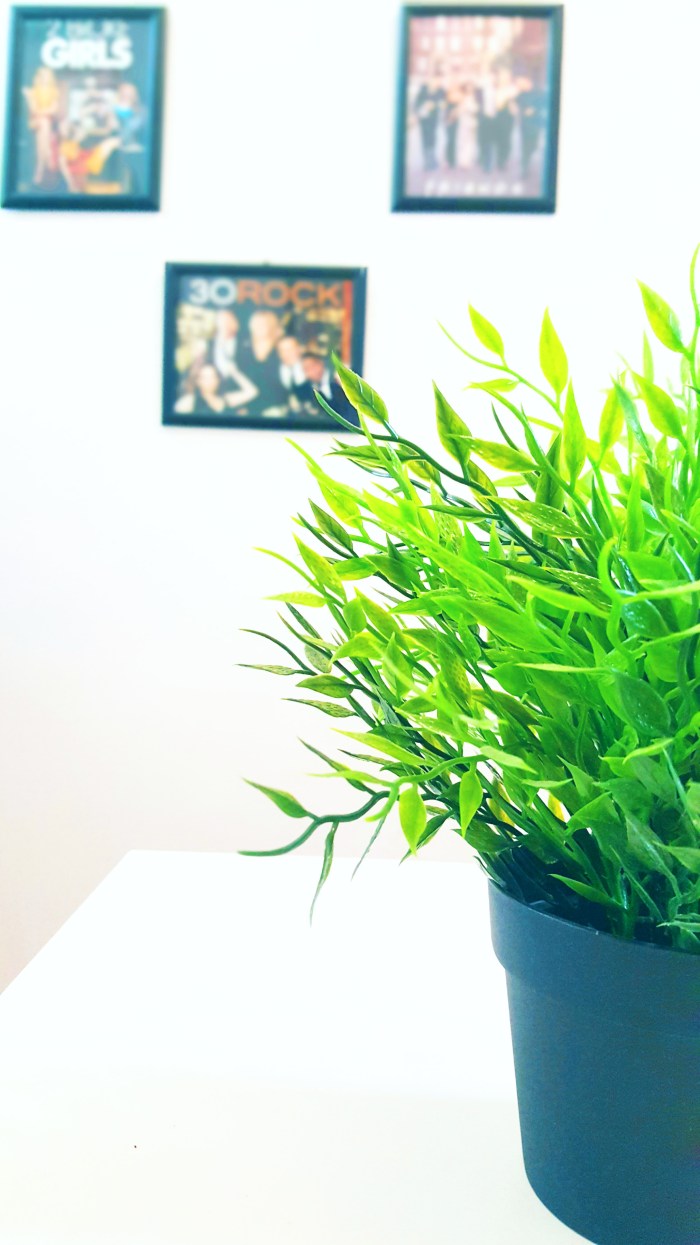
 

Plant and posters of favorite Tv showsRule 5: Achieving space separation and privacy

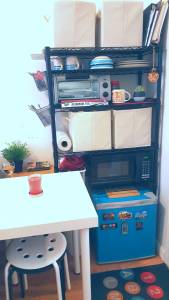
No, I don’t want the first thing people see is my bed when they enter my studio. Although I have a surprisingly long hallway with coats, hats and boots and the door to my private bathroom, being able to see the bed right after entering the studio is an awkward breach of privacy. So, I put the 9-cube organizer holding my tiny bar, DIY lights, a set of books and my art supplies hidden inside the cubes by the foot of the bed. It partially hid the bed and separated the sleeping space from living space by creating a visual barrier. The bright paintings and mixed media pieces hanged high did the rest of the trick to divert attention from the bed. A similar technique was used for the kitchen storage. As this apartment had no kitchen, I separated the refrigerator and the microwave using a storage shelf from Amazon placing it along the width of the studio right behind the couch. The open shelf serves as my pantry without blocking any natural light flowing in the kitchen.


Kitchen and pantryRule 6: Defining flow with color and light

In an open studio layout, a lot of designers define each space – cooking, living, study and sleeping, by different colors and textures of the furniture, paintings on the wall and rugs on the floor. That trick works in a slightly larger studio. But, for my 175 sq. ft. I had to find an alternative without making the place overwhelmingly crowded and looking like a mini-storage room. So, I used color and light to create a flow from one area to another. The blue and white of the sleeping area are accompanied by tiny green ferns in the windowsill (welcome to New York gift by cousin Ari) and a mixed media piece with bright green leafy patterns. This flows into the green couch and the greenish meditation posters in the living area. The pillows on the couch connect both color schemes with patterns of green and blue. Again, this flows into the kitchen area with green plants and the cyan colored tiny refrigerator before the red dining mats and the kitchen towels take over with a bright, energetic schema. The slight flow of color through each area gives the sense of openness by balancing the physical barriers created by the strategically placed furniture.
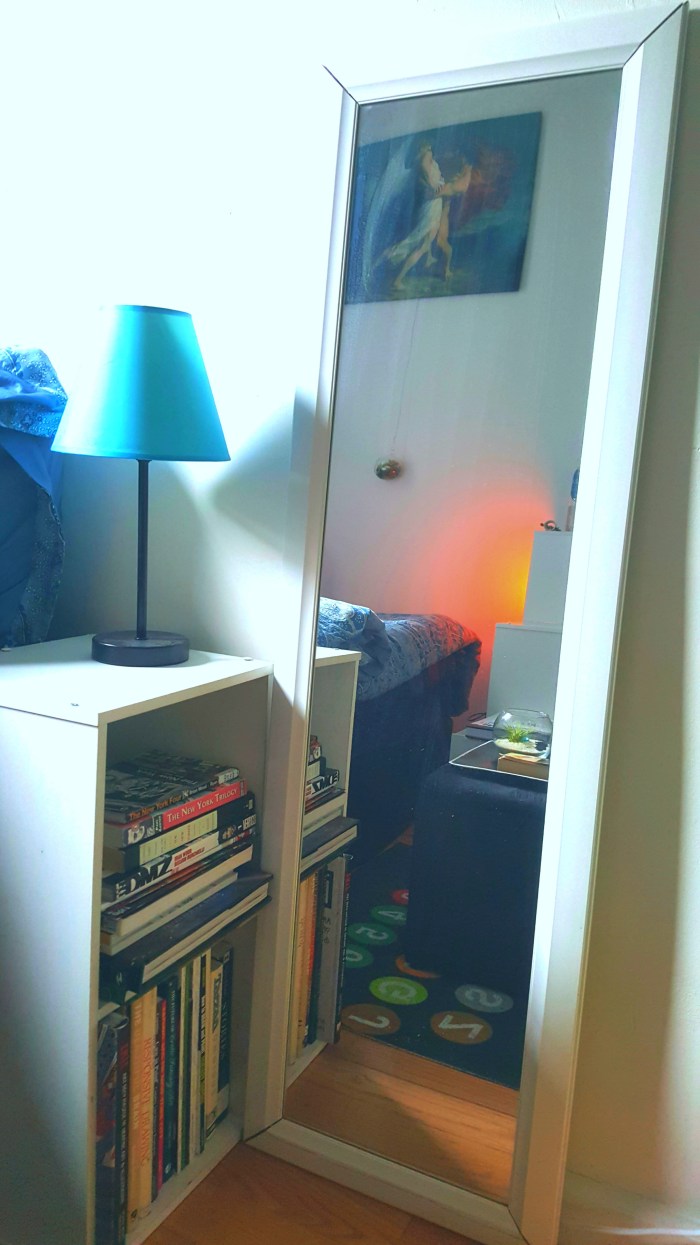
Mirror and bookshelf with nightlampI employed some of the well-known techniques, such as, use of the big mirrors to reflect natural light. But, they are so overly discussed everywhere else, I don’t have to. On the other hand, I avoided certain popular techniques, such as, white washing everything in the apartment to give the false impression of big and open. I wanted to embrace the smallness of the apartment instead of getting away from it. And honestly, everything white is not my style as it reminds me of the rooms of some mental asylums.

If there is a single element that binds every decoration decision of mine, it is New York City. Let it be the pillow cover with neighborhood-specific typography, the ikea-hacked tiny dining/study table, or the posters of New Yorker magazine and my favorite TV shows set in New York City. Many of these were created by my “Frank Sinatra” moments when I was away from the city terribly missing it. I’m that “third” New Yorker in E.B. White’s essay, who is a settler bringing in passion to the city of my last destination. And that’s the underlying element of each and everything I have in my nano-studio apartment.
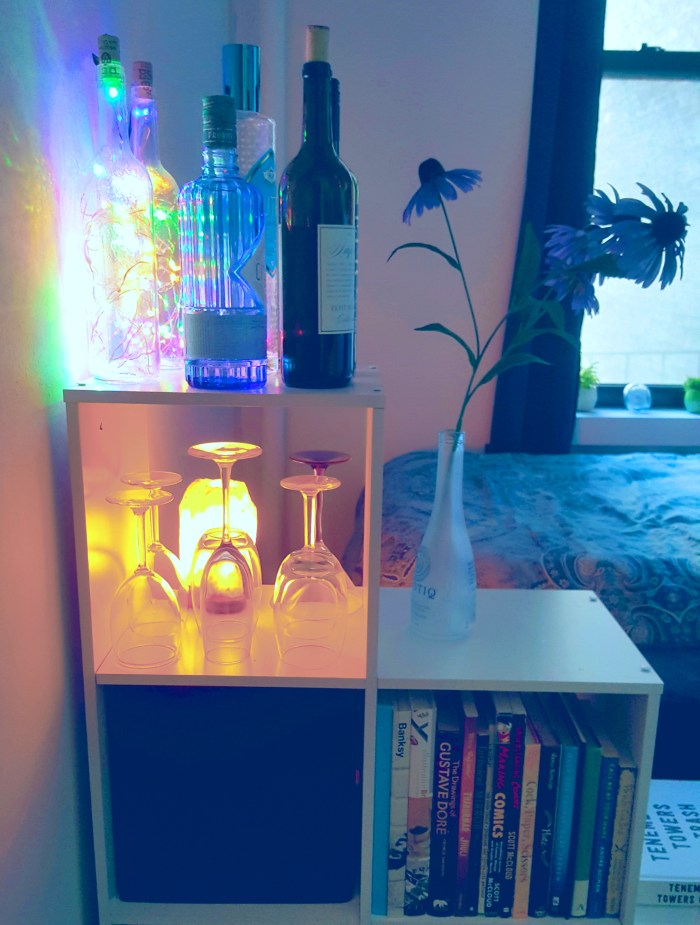
Cube divider bookshelf barLiving in a city that has so much to offer, I still need a place for solitary reflection – my sanctum sanctorum! I’m glad my nano-studio apartment serves that purpose to my satisfaction.
NYC Reality: the graphic novel with 3 intertwined timelines

layout test3
As I wrote earlier, this graphic novel has many of my favorite inspirational and artistic elements, such as, the Angel of Bethesda, the New York City subway, scientists and artists, Italian culture etc. But, just like every creative project, there are obstacles I needed to overcome and creative problems I needed to resolve. There are 2 major challenges I faced. First, creating an atmosphere from the place and time I have never been to can make it look fake and can have factual errors. Second, 3 intertwined timelines may impose a lot of unwanted ambiguity on the visuals and may confuse the readers.

1579e-20181211_121230
The entry to New York Transit Museum

My protagonist walks around 1982’s and 1989’s New York City. To make this believable, I researched how the city was back then. From New York Public Library, I found some archived images on Bethesda Terrace back in 1980’s. A visit to the New York Transit Museum informed me that back in 1980’s, people used the bronze transit coins as the MetroCard that we use now only started from 1995. This was a crucial piece of information as I imagined a close-up of my protagonist using these coins to enter the subway. Another major element of 1980’s subway was the graffiti. My own essay and research on graffiti at the Art Institute from 2013 came handy in this regard. Together, such detailed research gave me enough visual elements to create the 1980’s New York City.

The challenge of 3 intertwined timelines was my favorite. I deliberately wanted to make them visually and stylistically distinct. For the story line, 1989 is the current time and a very emotional time for my protagonist. So, I chose free-form panels and abstract paintings in the background to depict this emotional atmosphere. On the contrary, I followed the structured panels and somewhat dated colors and style, as found in Franco-Belgian comics like Tintin and Asterix, to draw the scenes from 1980’s New York City.

But, the third timeline is the trickiest because of 2 reasons: first, it takes place in 1983’s Northern Italy (where I have never been to) and, second, the film Call me by your name by Luca Guadagnino that inspired me to make this graphic novel was highly immersive (so I didn’t want to compete with that level of color, sound and texture). The solution to this problem came in a very unusual way.

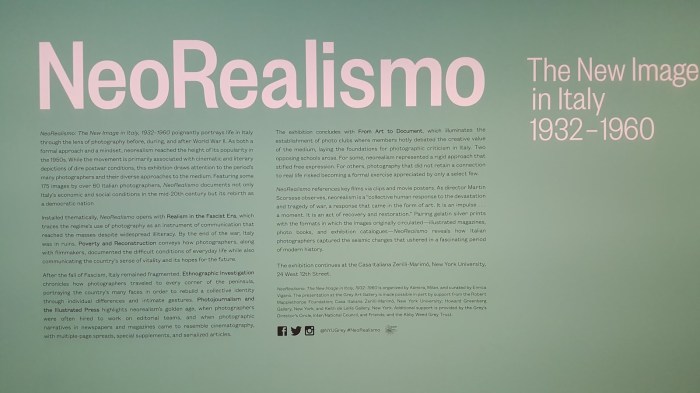
9e8b1-20181026_144626Back in October, when I was visiting New York City to look for apartments, my auntie, Cynthia took me to see an exhibit at the Grey Gallery of New York University. It was called NeoRealismo and luckily it showed photographs from 1960’s Italy. Most of the images were black and white with high contrast. From here, I got the idea of using black and white images so that I leave the choice of colors to the readers’ imagination. For the style, I chose completely analog technique – charcoal on paper. This immediately created a sharp contrast with my otherwise semi-digital styles of the scenes in 1980’s New York City.

Although, so far, I only created 5 pages of this novel, all 5 of them were pivotal scenes and they standardized my visual choices which will be applied to the rest of the novel. I’m sure there will be new challenges as I work my way through this big project. But, I’m sure the fire in my heart will show me the way to solutions that the readers will appreciate.

What a beautiful way to begin a new year! Peace and Love!

NYC Reality: To cook or not to cook living in the East Village

It’s been almost 3 weeks since I moved to the supremely micro matchbox apartment in East Village without kitchen. My friends back in Dallas kept texting and calling me to make sure I’m alive and they shuddered at the thought of how tiny the square footage is and how I’m living without a kitchen. So here are couple of myths and how I broke them.
Myth 1: NYC is extremely expensive to do grocery
Reality 1: Most grocery stores in Manhattan are 200% more expensive for most of the items I used to buy in Dallas. However, there are smaller neighborhood groceries, located in middle income group neighborhoods, where you can pay the same money for the same food as you pay in Dallas. For example, my nearest grocery stores are on 2nd Avenue and they are very expensive- $7 for half a pound of butter or $9 for a bottle of cooking wine. However, if I walk for 15 minutes towards East River through Alphabet city, I can do my grocery at a Hispanic store at exactly the same price I did in Dallas.
A $10 claypot meal in a hole in the wall
tiny Cantonese restaurant

Myth 2: If you eat out every day, you will be sick and bankrupt

Reality 2: NYC is full of fancy, expensive, fusion and authentic restaurants. Yes, at my salary, I will be bankrupt within a week if I eat out every day in those places. But, a lot of people don’t know that NYC also has a lot of tiny hole in the wall restaurants where you can find very good quality, balanced and healthy meals within and around $10. NYC street meat stores have bad reputation and horror stories about their lack of hygiene. But, for past 5 years for my 14 visits to NYC I always tried the street meat carts standing by the side of busy streets and never got sick. As you can pretty much walk everywhere, you can also get fantastic carryout deals in pizza places. So, the verdict is – if your stomach can handle NYC street meat and you can spend time looking at discounts, you will be fine.
Myth 3: A cocktail will cost you $25 in NYC
Amazing price at a tiny bar in my neighborhood

Reality 3: As long as all you are not a queen for crazy expensive SpeakEasies or fancy cocktail bars, you can find many hole in the wall neighborhood bars where locals go. I have a bar within 5 minutes’ walk from my place, where you can find good branded whisky such as Johny Walker for $5, Bombay Sapphire gin and tonic for $4 and several signature cocktails ranging from $6-$10. I also found an alcohol store that sells imported wine and liquors in supremely low prices. Can you imagine a bottle of Rose’ from Greece for $6? Yup!

Honestly, you just need to explore the city on your own and take all the advice you get from others, including from those who claim themselves as native New Yorkers, with a grain of salt. NYC is a very rapidly-changing and dynamic city. So, trust yourself and you can find good quality and cheap places.
For me personally there are three main reasons for not cooking at home.
First, I hate doing dishes. Dishwasher is a dream for NYC studio apartments in lower Manhattan unless you make $150k and can afford one of the newly renovated lofts in SoHo. I don’t. So, for me, no cooking equals to no dishes equals to happier me.
Second, who wants to waste time cooking? Back in Dallas, I did not have enough good quality (yes, I’m a snob about art) art events to go to. So, I cooked while drinking wine and watching Friends, 2 Broke Girls or 30 Rock! Here, my weeknights are always flooded with open gallery events at Chelsea or Williamsburg and free hours at the art museums. I’m not Julie Powell or Monica Geller. Do you really expect me to stay in my micro studio and cook instead of checking these awesome art pieces out while drinking wine!
Finally, old buildings like mine in lower Manhattan will attract roaches. NYC has millions of horror stories about big rats and garden size roaches. If I do not cook at home, I’m probably safer in this regard.
In conclusion, for a 94% extroverted scientist and artist like me who loves to strategize, prioritize and plan about food, who gets immense amount of pleasure in figuring out discounted coupons and deals, in finding out underground, hole in the wall shops, bars and restaurants walking or travelling by the subway through the whole city, a solitary activity like cooking is depressing, boring and totally NAY!

NYC Reality: The apartment hunting

200 listings on 5 websites, 15 documents, 20 brokers, 12 viewing, 1 cousin, 1 friend, 2 aunties, 3 applications, 7 days, 2 approvals = 1 place to rest my head is secured in East Village. So how did it happen?

For past 5 years, I researched about all the unusual things about renting an apartment in NYC: the crazy high rent, 15 different documents including credit check, the paucity of rent stabilized and affordable apartments etc. So, I wasn’t surprised by the amount of effort I had to put in to find a place to live in the city. The off-campus housing pages on the university websites were highly informative too as not all employees can get campus housing due to long wait lists. Most importantly, my native New Yorker friends and family gave me some really good advice about this process.
I was visiting the city for a conference 5 week before my intended move. Before I reached the city, I looked up around 200 available listings on Naked Apartment (which had listings with lower broker fees), Rent Hop (which had reliable listings), Street Easy, NYbits (not at all user friendly) and Zumper. I also contacted approximately 20 brokers by email and phone so that I could confirm the appointments for the viewing during those days. I knew the good ones can be taken off the market within an hour of the viewing. So, I made a 3-ring binder with all 15 of my documents required for the application. The idea was, if I liked something, I immediately would put down my application. I also spoke to George, a friend living in the city, who gave me a lot of valuable advice.
There are were 3 unique and enjoyable experiences during this process.
The first one is an apartment in Flushing, Queens. It was a 15 ft by 20 ft studio with kitchenette along one wall and big glass window on the opposite side. There were plenty of space for living, dining and sleeping in NYC standard. However, the most surprising thing was the shower. Right in the middle of this room was a vintage, brass bathtub with built-in shower isolated from the rest of the room by shower rods and curtains! I believe, the whole place was a luxurious bathroom at some point which was later converted into an apartment. I wasn’t upset as I didn’t like the neighborhood and I knew that the 7 train, only subway in that area will be shut down soon.
The second experience was in Chelsea. The neighborhood is of course fantastic and pretty close to my work at Upper West Side. The studio cannot be larger than 96 square ft. There is a kitchenette along one wall and there is a very narrow loft on top of that accessed by a ladder. I have seen such places before in big cities. There were 4 young professionals including me who came to the viewing. One of us was lying down on the floor to see if her stretched out hands could touch both the walls. They did not. But, while trying to get up, she started rolling. Being curious, I crouched down and found out that the floor had a significant slant! The broker explained that the downstairs neighbor had a slanted ceiling. I believe the builders didn’t do a good job leveling the floor.
The third experience was regarding home sharing. There are non-profit organizations funded by the city who pair up senior house owners with young students and professionals looking for renting a room. They do this match by an extensive questionnaire on the lifestyle of both the host and the guest. The application process also requires 3 personal recommendation letters from people who are residing in the city but are not colleagues or a family members. Auntie Cynthia and auntie Beth wrote two letters for me. My previous landlord Michael from Dallas wrote me a very good third letter. Although I did not end up taking up a place through this program, I was highly impressed by how friendly, fast and easy this program was.
I met couple of friendly and helpful brokers as well. 

Yelena became a good friend of mine. I spoke to her about the East Village listing over the phone from Dallas. She understood my interest, the strengths and weaknesses of my application materials and advised me accordingly so that the application looks strong. She also told me her story and I told her mine during our walk to respective subways. On the day of lease signing while coming directly from the airport the latch of my big trolley bag broke. Yelena, dragged this bag for a block to help me after the lease signing was over. New York, where act of random kindness is difficult to spot, I found a real estate agent with a heart.

Then there was Will. I never met Will in person and we only communicated by emails and texts. But, he was kind with his time, advice and made me feel excited about this long process. He specialized in lower Manhattan and most of the listings were way above my budget. However, he connected me with his long time friend, Kolette, who had more information about some listings at Upper West Side, close to my work. 

I ended up doing 3 applications, one in West Village, one is Morningside Heights and one in East Village, as I didn’t know which one would get approved. The West Village one was the smallest and had the best location. The Morningside apartment was the closest to my work and had a full kitchen and bathroom.

However, in the end, the East Village apartment, my favorite one, got approved. It is only 175 sq. ft., but a super cute, sunny and clean place with private bathroom, nicely insulated window facing a beautiful courtyard (meaning no smell of garbage) and high ceilings. It’s an SRO (Single Room Occupancy meaning Standing Room Only) that was an orphanage in 1910. Pets are not allowed (meaning my upstairs neighbor’s dog doesn’t run around all night long making terrible noise or my downstairs neighbor’s cat doesn’t come in through my window to poop in my apartment). The building is rent stabilized as I found in the official public records. I loved the history associated with the building and found out that most of my neighbors are young students at NYU or young professionals like me.

The funny thing was everyone in New York congratulated me once I told them I found this place. I was surprised as it was not like I won an award or something. But, I understood later that being able to rent an apartment is considered an ordeal in New York City.

NYC Reality: The warrior of light – from dream to reality

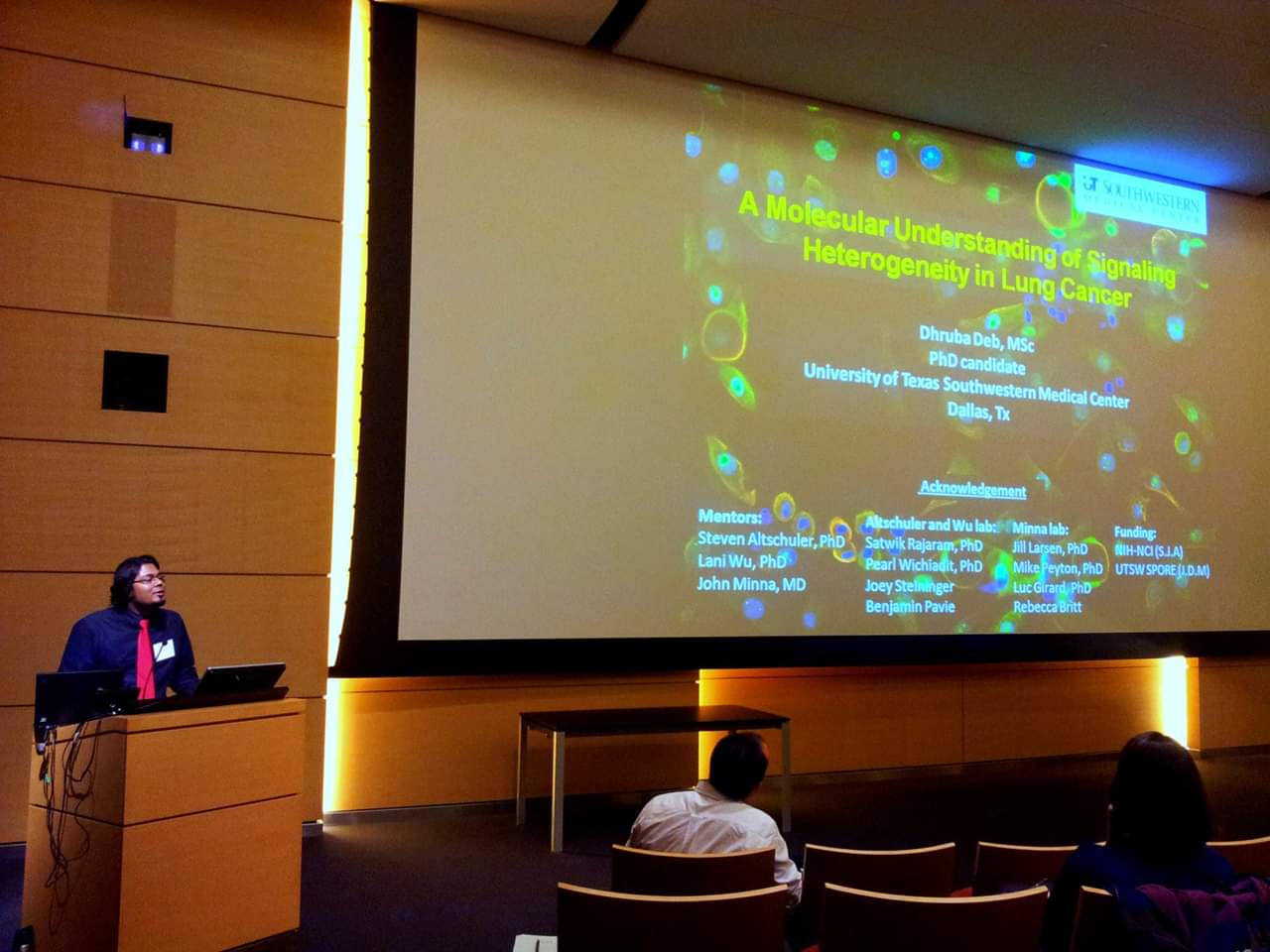
My “Young Scientist Award” talk at MSKCC

I fell in love with NYC back in 2013 when I received the “Young Scientist Award” from Memorial Sloan Kettering Cancer Center (MSKCC). I was staying with my cousin at Rockville Centre, Long Island, but was commuting to the city everyday by LIRR. The music and art performances of MUNY built the first connection to my heart. Living in Dallas, TX, where good quality art and music were rare to find in everyday life, I immediately felt at home in NYC. The second connection was the public transport. I never liked the culture of “my car is my second home” and always wanted to be able to walk everywhere anytime of the day or night. The final connection was the biomedical research. There are 7 fantastic research institutes in the city itself who can collaborate with each other to carry out cutting-edge research. Since then I knew this is where I belong.

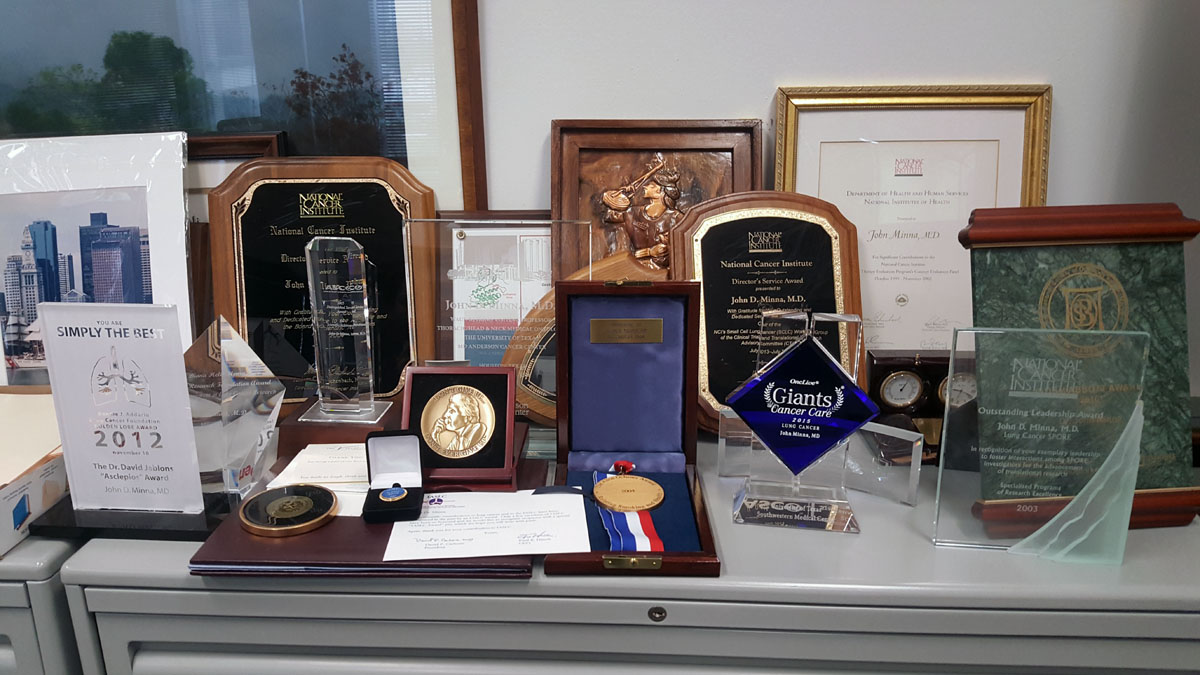
Only a fraction of awards received by my former mentor
Dr. John Minna, MD, at UT Southwestern, Dallas

But, the impediment to moving to NYC was two-fold. First, I needed to find a job where I could be
happy. Second, having worked with Dr. John Minna, one of the top 5 lung cancer researchers in the world, it was very difficult to find another equally good lung cancer research lab. For past 5 years I interviewed for 8 different positions in 4 places. But, to my surprise, I found even very famous scientists may have really bad lab culture and no appreciation for art. Then there always was the visa issue with international applicants like me.

Of course, there were moments, specially in 2016, when I felt like my NYC dream would never come true. But, overall, I kept pushing. And used my natural, magical power – keep building relationship with people in NYC during my short visits to the city and with people in Dallas who understood my interest.
I hoped one day an opportunity will come. And it did.
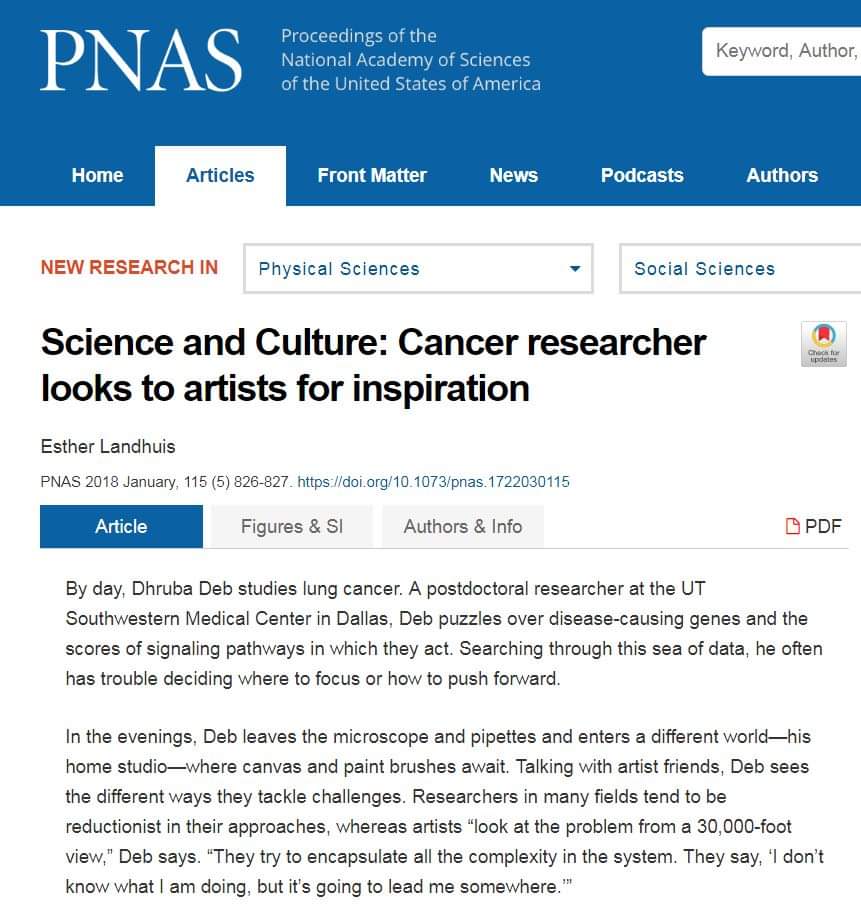
The PNAS feature article on my work

In 2017, Dr. Roger Malina, one of my unofficial mentors, directed a scientific writer to me. The writer, Dr. Esther Landhuis, a Harvard trained immunologist was looking for a story for PNAS where art and science of cancer could show promising results helping the mankind. My Cancer ARTSCI Network was the perfect fit. While writing this story, Esther asked around other trailblazers working in art and science hybrid projects about my work. One of them was Dr. Tal Danino, who without ever knowing me, said couple of nice words about my work.

Next, 3 important changes happened around me.
First, Tal found out from Esther that I’m the section editor of Leonardo Journal published from MIT press and contacted me with the interest of publishing couple of articles. Fortunately, I was in NYC during that time and I stopped by his lab. I found the research exciting and very importantly, the science- art hybrid projects interesting.
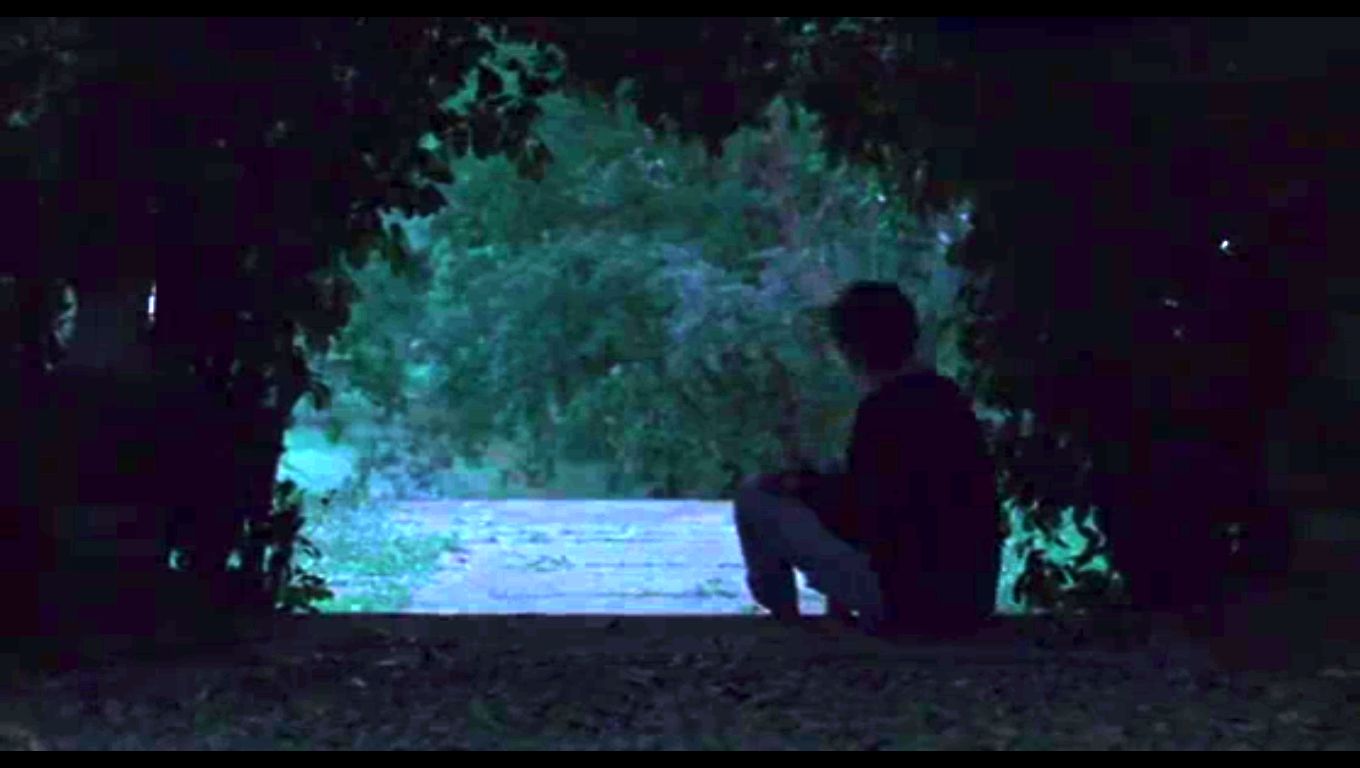
My favorite scene from the film “Call me by your name

Second, by sheer dumb luck, I watched an European art-house film named, Call me by your name, that broke my obsession for NYC and replaced it with pure love. As a result, when I met Tal and expressed an interest in interviewing for a position with him, I was not expressing an urge to move to NYC and was relaxed. Being a Californian, Tal probably liked my relaxed and creative personality.
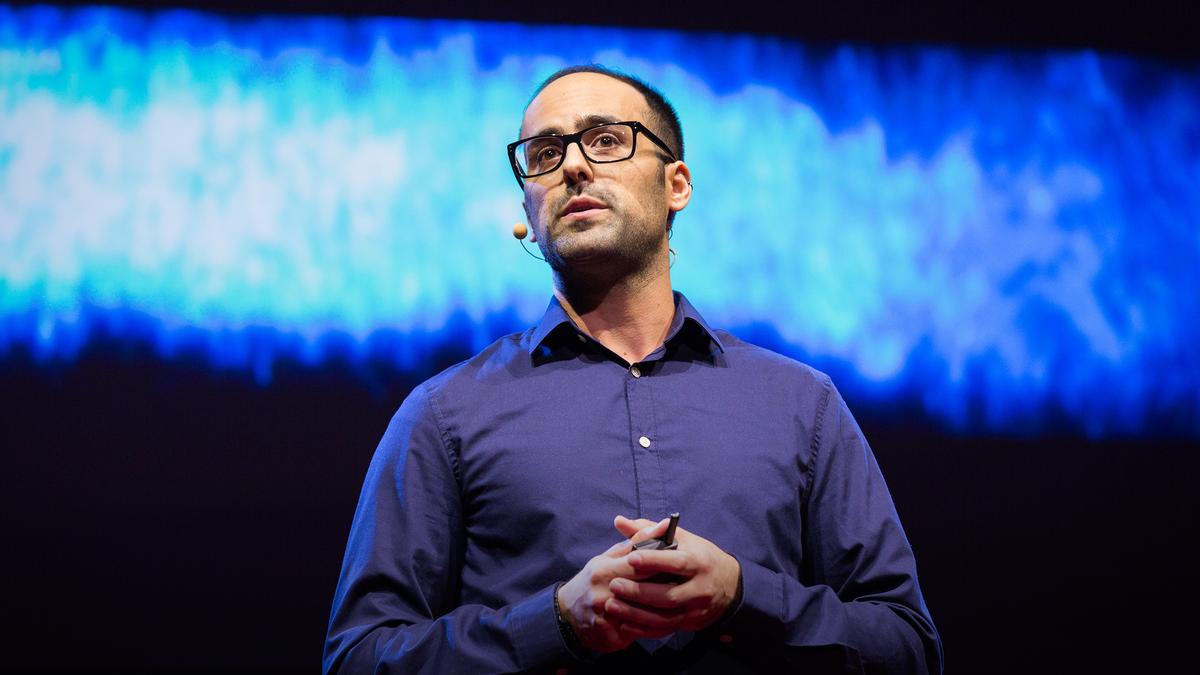
My mentor, Dr. Tal Danino, PhD, talking about
art and science of microorganisms and
cancer in a TEDx talk

Third, a research personnel in Tal’s lab left and went back to China opening up a space for me in Tal’s lab in Columbia University. The moment Tal made me an offer, I told Dr. Minna about it. Of course, knowing me for past 10 years, Dr. Minna was aware of my friends, family and my heart’s connection to NYC. So, he immediately came on board with my plan so that I could finish up the work in his lab back in UT Southwestern, Dallas, before I move to NYC.

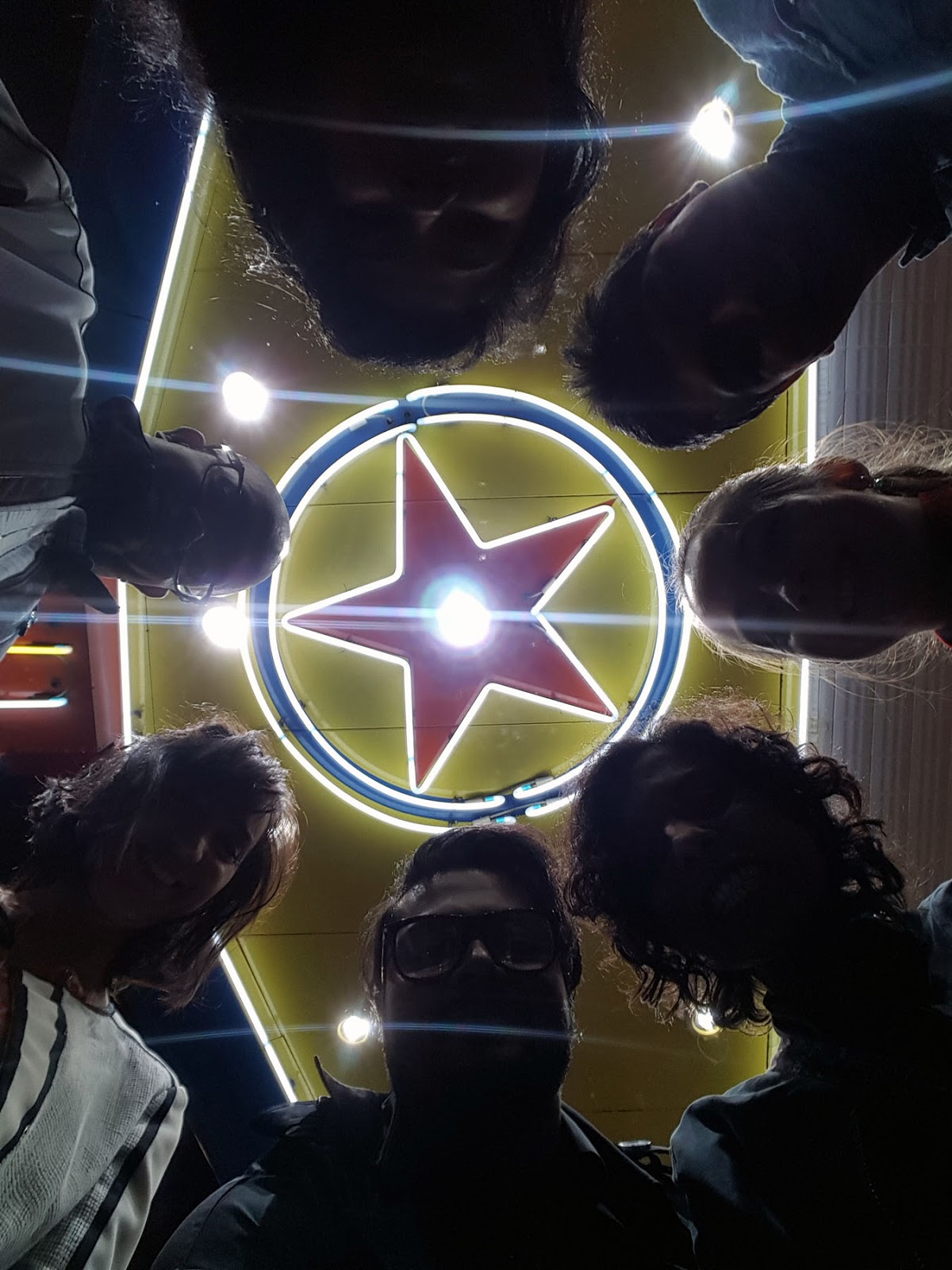
Some of my close Dallas friends
without whom I’ll be so lost

My Dallas friends, Jessica, Ranjula, James, Silvia, Emmanuel, Robin and my Cincinnati friends, Cristina and Caterina, my cousin Arindam and my aunties Beth and Cynthia in NYC were excellent support systems for me during this very long and dark journey of turning my dream into reality. I will end this post with a quotation from Paolo Coelho, that Jessica introduced me to:

“The warrior of light is a believer.
Because he believes in miracles, miracles begin to happen. Because he is sure that his thoughts can change his life, his life begins to change. Because he is certain that he will find love, love appears.”

NYC dream: Swan Lake, angel of Bethesda, AlCopley, tiny apartment and Little Italy

Earlier this year a European art house film ignited a fire in my heart and that led to writing 25 pages long script of a graphic novel. When the opportunity came to put the words into the images, I started to combine inspirations from various sources. Essentially, all the major elements of my previous blog posts from past 5 years showed up in my creation: the 1989 Bolshoi version of Swan Lake, my obsession with the angel of Bethesda in Central Park, my interest in trailblazers from the past who successfully incorporated both art and science in their lives, the teeny tiny apartments in New York City and my newly discovered Italian connection.

Page 1The first page took me the longest. I wanted it to immediately draw the readers in, have a strong and complex visual and a conflict of the protagonist that attracts the readers’ empathy. I think my interest in dramatic perspective and videography with wide, total, half-total and close-up shots helped my storyboard design. With several layers of analog and digital paintings, mixed media pieces and typography motivated by a very purple mood board finally created what I wanted!

1989 Bolshoi version was unique as in the last scene when the evil wizard is trying to kill the prince, the swan queen throws herself in between them and as a result the power of the love of the prince and the swan queen wins over the dark magic of the wizard ultimately killing the later. In this version, the swan queen is not only a beautiful and fragile damsel in distress, but eventually turns out to be a powerful shield protecting her prince. I wanted the protagonist watching Swan Lake in Lincoln Centre, to completely immerse in this moment and wanted a flashback from his own life that reminded him of a similarly empowering moment of love.

Immediately, the protagonist is back in his past! It’s summer of 1982 when he decided to apply for an Italian internship. Of course, he researched several equally prestigious opportunities elsewhere. But, standing in front of the Bethesda fountain and noticing the details on the face of the angel reminded him of his love for Hellenistic sculptures. The key frame in this second page, is thus the angel. So, I drew her with more details than anything else on this page. As the protagonist slowly walks away from the fountain, lost in his thoughts, he knew he needed strong recommendation letters.

That’s where my research on the physician scientist Dr. Copley a.k.a. the artist AlCopley, came handy. When I met Al’s daughter Una back in early 2016 in New York, hearing that I’m inspired by Al and his life in combining biomedical science and fine art, her husband Scott gave me copies of Al’s shows from the past. I found that in 1982, Al was showing his work in the City Gallery near Columbus Circle. So, this gallery became my venue where I wanted the protagonist to network with famous (and sometime highly controversial) people in the art world that ultimately led to the recommendation letter he wanted for his internship application.

In the last part of the third page, my interest in tiny apartments and learning Italian became highly useful. The protagonist’s study table in his tiny apartment showed his books, word processor (remember it’s 1982!) and the letters addressed to a professor of art history and a publisher in Italy. I wrote the address in Italian!

Soon, I will start working on next pages where the protagonist goes through another time frame, the summer of 1983. There will be some overlap with scenes and stories with the film that inspired me. As the film set in 1983 summer used a very unique cinematography and storytelling technique of immersive cinema stimulating the viewers’ eyes with colors, I want to take a different approach. I’m thinking about the black and white style of Japanese Manga minus the large eyes and huge hair.
The stark contrast in style for the first page with the second and third were intentional and I hope as the novel progresses the readers will be able to understand and connect each style with a different time frame.