The unparalleled predisposition of visual, literary, and performance art in New York sets an extraordinarily high bar for any creative expression.
Even a personal love letter to this city can feel insignificant before it begins, overshadowed by my admiration for the standards set by E.B. White’s Here is New York, Joan Didion’s Goodbye to All That, Woody Allen’s Manhattan, and Frank Sinatra’s New York, New York. Their New Yorks feel complete, as though the city has already been fully observed, fully interpreted.
And yet—here goes an insignificant love letter.
Eight years ago, when I moved to New York for good, I set one non-negotiable rule for myself: I would pursue cancer research and visual art in parallel, in the city I had long believed to be my final destination.
Arriving here on my own terms took years of preparation. But once I was here, what surprised me most was how quickly strangers became friends, and friends became collaborators—each of them bound by a shared, almost reverential love for this city.
Perhaps it was that collective passion that gave rise to an idea—one that brought together biomedical research and visual art, rooted deeply in New York itself.
We set out to explore the extent of diversity in this city—not just through its people, natives, commuters and transplants alike, but through the invisible ecosystems beneath our feet.
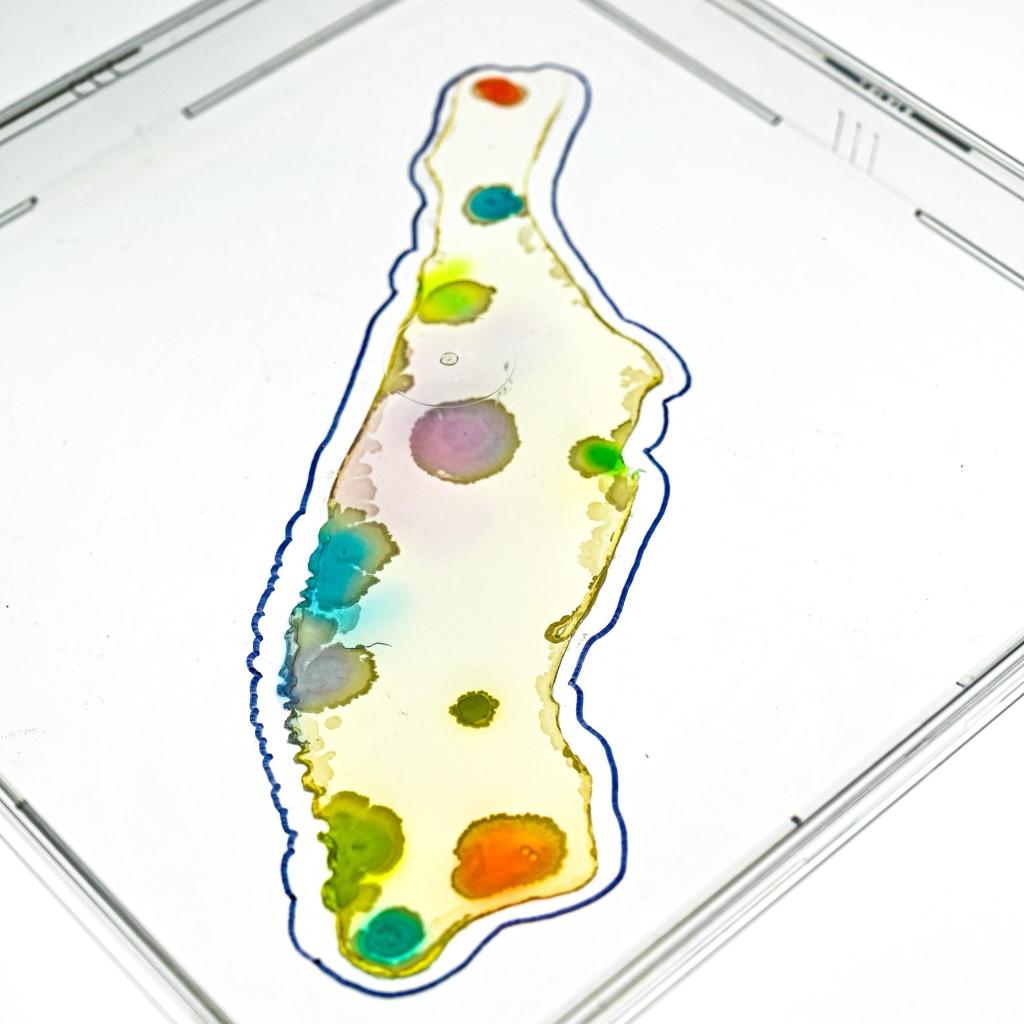
Our team collected soil samples from 25 public parks across Manhattan and isolated the dominant bacterial species from each.
The scientists among us pushed further, asking whether natural secretions from these bacteria might possess the ability to eliminate cancer cells.
The artists, meanwhile, followed a different instinct. They sought to reimagine neighborhood boundaries—not through maps or history, but through the growth patterns of these microbial colonies.
Slowly, patterns began to emerge.
The scientists found that several Bacillus species produced natural compounds capable of clearing out lung cancer cells—and the effect became stronger as the amount increased. What began as an exploratory exercise evolved into a discovery platform—one that hinted at the potential of urban soil bacteria as future microbial cancer therapies (link).
The artists observed something equally striking. When each dominant bacterial strain was allowed to grow from its original geographic position within a Manhattan-shaped nutrient landscape—scaled to reflect the distances among neighborhood parks—the colonies did not remain confined. They expanded, collided, competed, and overtook one another. Boundaries dissolved. Territories shifted. What emerged was not a static map, but a living, contested, ever-evolving city.
And somewhere between these two trajectories—one seeking to heal, the other to interpret—I began to understand New York in a new way.
This city is not defined by its borders, but by its collisions.
Its energy comes from overlap—of disciplines, of cultures, of ambitions. Just like those bacterial colonies, we arrive with origins, but we do not remain contained by them. We expand, we adapt, we collaborate. We shape the city, and in return, the city reshapes us.
And cancer, in its own unsettling way, reflects this truth back to us. It is not merely a disease to be eradicated, but a distorted echo of life’s most fundamental processes—growth, adaptation, and possibilities. To study cancer is, in part, to study health itself: to understand what happens when the very systems that sustain life lose their balance, their restraint, their sense of collective harmony.
In that sense, the bacteria beneath New York and the cells within us are not so different. Both reveal how life organizes, negotiates space, responds to pressure, and, at times, spirals into chaos. And yet, within that chaos lies the possibility of orderly insight—of learning how to restore equilibrium, how to guide growth back toward coherence.
Perhaps that is what this city has been teaching me all along.
That health—whether of a body, a community, or a city—is not the absence of conflict, but the ability to hold it, regulate it, and evolve through it.
Perhaps that is why New York feels alive in a way no other place does.
So yes, this may be an insignificant love letter.
But what I have come to understand is that neither the city nor the body is defined by its boundaries alone, but by the conditions that allow those boundaries to hold, to shift, and, when necessary, to be reimagined.
And in that recognition, New York is no longer only a place I inhabit.
It becomes, instead, a way of thinking about life itself.

