NYC dream: Adaptation of Swan Lake to Black Swan to a Medieval Style Painting

Unlike many American children, I did not grow up listening to Tchaikovsky’s famous composition of “Swan Lake”. Neither did I grow up watching my sisters practicing ballet wearing their tutu. While growing up, I have watched classical Indian dance performances, such as, Bharat Natyam, Kathak and Odissi. Among them, the dance form Kathak caught my attention because of the involvement of incredibly fast spins. I was always amazed and curious by the fact that the dancer did not faint after taking so many fast spins and still stood a farm pose in the end smiling at the audience. I did not know that ballet had similar spins called “fouette”. To my astonishment, in 2011, for the first time I experienced this similarity while watching Darren Aronofsky’s phychological thriller film “Black Swan”.

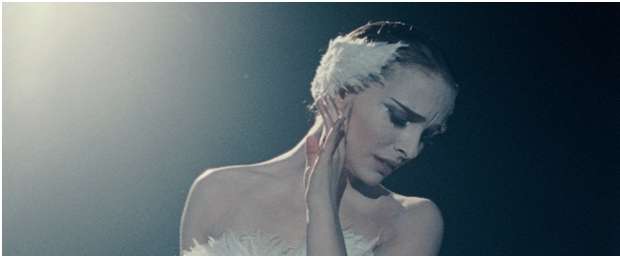
Black Swan talks about the journey of a ballerina, Nina Sayers, to perform “perfectly” as the Swan Queen in a ballet company at New York City. Nina has been a perfect choice for the Swan Queen for her excellent precision, innocence and fragile presence.

However, to play the Swan Queen, Nina also needs to dance the evil double, Black Swan. Black Swan is a seductress. Another ballerina Lilly is a perfect embodiment of Black Swan. Lilly’s moves are “imprecise, but effortless”. Nina feels immense amount of pressure to compete with Lilly in real life as well as in the performance. During this process, she develops paranoid schizophrenia. She starts to experience a doppleganger, who is confident, seductive, and a perfect fit for Black Swan.

On the night of the show, Nina embodies both white and black swan with “perfection”, but in the process hurts herself.
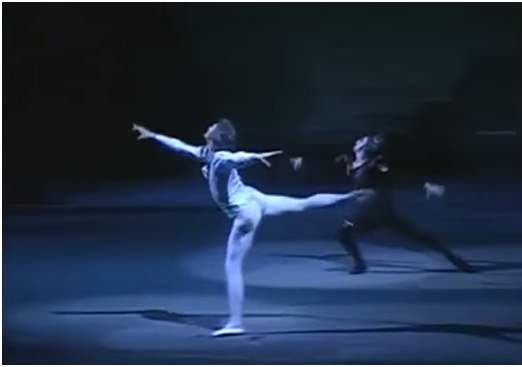
After experiencing the Black Swan dance scene in the film, I went back and looked up for the original Swan Lake. There has been many versions of Tchaikovsky’s Swan Lake. The version that caught my attention was Bolshoi’s 1989 production. Alla Mickalchanko played the role of the Swan Queen. The revised choreography was composed by Yuri Grigorovich. There were three unique twists in this composition. First, the Evil Wizard, Rothbert, was a twin of the hero prince, creating a psychological thriller. The audience was left with the assumption that both good and evil resided inside the Prince. Additionally, the Prince and Rothbert danced the similar steps indicating evil Rothbert’s influence over the good Prince.

Second, Alla Mickalchenko’s bold, fast, dramatic and “a bit rustic” style reminded me of Lilly’s imprecise and effortless performance in Black Swan. Finally, in the happy ending version, when Rothbert tries to kill the Prince, the Swan Queen throws herself in front of the prince and their love not only protects them from Rothbert but it kills him breaking his curse. Alla Mickalchenko’s bold presence created the perfect shield in this scene to protect the Prince against Rothbert.

The fight between good and evil is an ancient theme in all forms of literature and art. The reason for such frequent repetition of the same theme may be because art and literature get motivation from real life. From my personal life experience, the journey of a scientist in the field of biomedical science, I have observed that many of us get seduced by the glamorous publications in high impact factor journals and do not notice their lack of practical application in the clinic. Fortunately, life always gives us a second chance. Hence, the seduction of the prince by Black Swan, the conspiracy of the evil Rothbart, and finally regret and realization of Prince – all are metaphors from our lives.

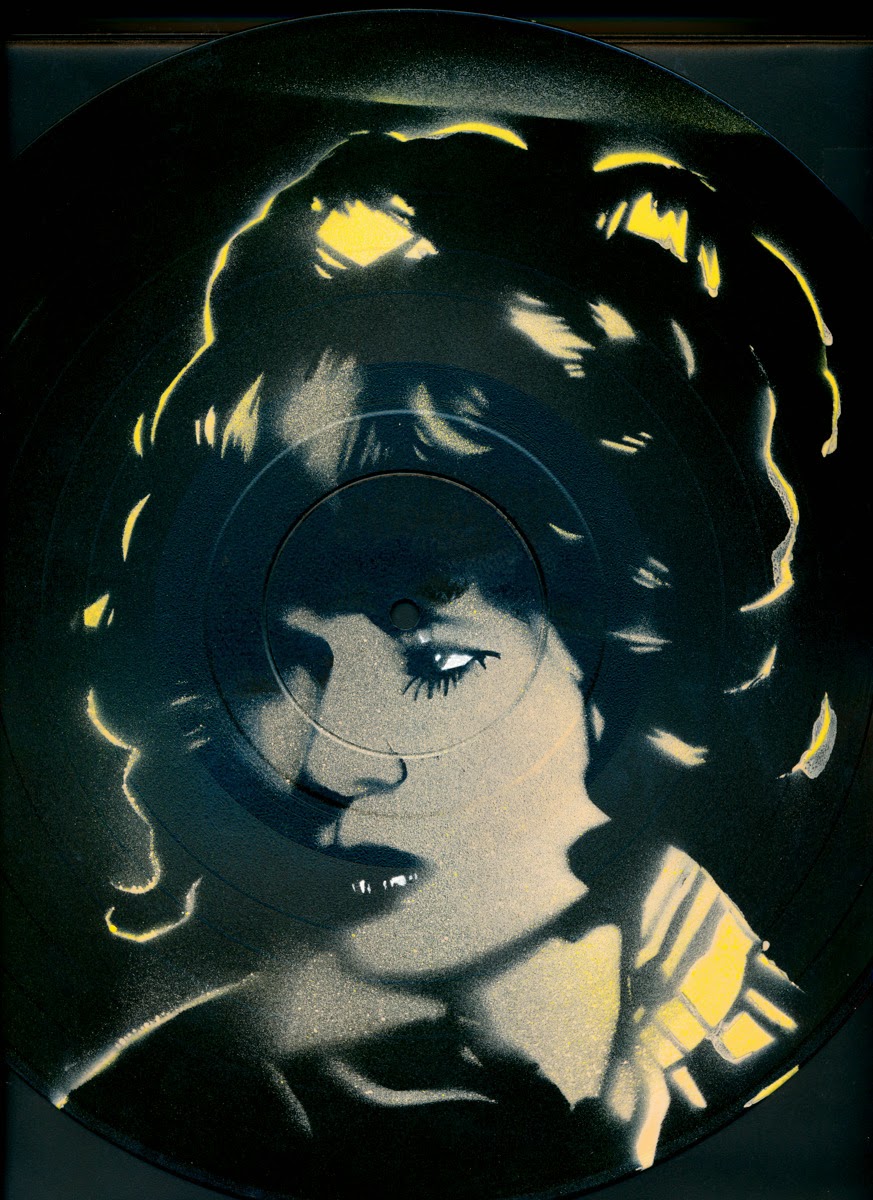
Once I realized this epipheny I wanted to channel my emotion in creating a painting depicting the psychological fight between the good and the evil in the thematic background of Swan Lake. In my painting, I have portrayed the scene where the Prince asks the Black Swan’s hand for marriage. To represent royalty and wealth, the Prince is painted with golden yellow. The White Swan appears as a vision in the background to warn the Prince. The Black Swan turns him down and with the Evil Wizard leaves the ballroom victoriously. The Evil Wizard is painted in pitch black and almost as a shadow of the Black Swan to show his control over her. The most prominent literal element is the veil of Bolshoi production with a white and a black swan facing each other. The most prominent figurative elements are the wings of White and Black Swan. White Swan’s wing points downward to match with her innocence and fragility. On the contrary, Black Swan’s wing points upward to match with her confidence and victory. In general, the style of the illustration is similar to Medieval paintings where the figures are forcibly two dimensional. The painting, overall depicts the struggle each one of us face while making each choice in our life with a constant battle between good and evil within our mind.

References:

1. Review of Bolshoi’s 1989 Swan Lake
 , 
accessed on March 2, 2015
2. Video of Bolshoi Swan Lake 1989 production
 , 
accessed on March 2, 2015
3. Black Swan film information in wikipedia 
accessed on March 2, 2015
4. Black Swan film information in IMDB 
accessed on March 2, 2015

NYC dream: A sculpture on breast cancer

I did this assignment for Dr. Anne Perry’s Humanities class at the Art Institute of Dallas.

Sculptor: Abou Farman and Leonor Caraballo

Bio. Summary: Abou Farman and Leonor Caraballo, have been working in video, installation, and photography since 2001. Their work focuses on public ritual and collective acts exploring the relationship between individuals and groups, unit and structure, and ways in which one enables the other while also dissolving it. Their work has been exhibited worldwide, including The Tate Modern (London), PS1/MOMA, The Project Gallery(NY), The Whitney ISP(NY), Artists Space, The Havana Biennial (Cuba), Cuenca Biennial (Ecuador), Impakt Festival (Netherlands). They have won several awards and grants including a Canada Council grant in Media Arts and The New York Community Trust. Leonor Caraballo was diagnosed with breast cancer in 2008. As of 2014, she is cancer-free.

Source (s): 1. Facebook 18 Oct. 2014

2. Eyebeam 18 Oct. 2014

Artwork title: Ruins (Carcinomas)

Commentary on art: Ruins (Carcinomas) highlights breast cancer’s links to carcinogens in our everyday environment. Depicting fallen urban landscapes over-run with tumors, the pieces are based on breast cancer tumor forms, imaged and “digitally removed” through a special process devised by caraballo-farman, that combines Magnetic Resonance Imaging and rapid prototyping. The grey ‘support material’ used by 3D printers to build up a form is generally meant to be removed. But the artists used Eyebeam’s 3D printer in such a way as to maximize the architectural form of the printer’s support structures and then hacked at the structures to partially reveal the white tumor embedded.


Source(s): 1. Youtube 18 Oct. 2014

2. Studio360 18 Oct. 2014 < http://www.studio360.org/story/227070-object-breast-cancer/>

3. Website 18 Oct 2014

Personal response: 1. Dimensionality – Full round, 2. Method of execution – Both construction and substitution 3. Composition – Small mass, grey and white colored sculpture. Very distinct lines were used to depict the ruins, but diffused forms were used to depict the tumor 4. Principles – A rectangular structure is repeated many times to describe the ruins. There is clever use of negative space to slightly separate different architectural ruins. 5. Focal point – The upper detailed construct of ruins right above the white and cloudy tumorous mass. Viewer’s eye starts at the wide bottom, moves upward towards the cloudy tumor mass. At this point, the emotional dialogue between the viewer and the sculpture is the maximum. Then, as the sculptors intended a victory of the survivor over the tumor, the viewer’s eye travels further up to the details of the ruins leaving the emotional dialogue with the tumor behind them. This bottom up approach represents Leonor Caraballo’s personal experience of rising above the fight with breast cancer in her life.

NYC dream: A cognitive model of cancer signaling in painting

I wrote this as an assignment for Dr. Anne Perry’s Humanities class at the Art Institute. Interestingly, later, I had a chance to meet Steven J. Oscherwitz in person for a Leonardo meeting.

Visual Artist: Steven J. Oscherwitz

Bio. Summary: Steven J. Oscherwitz is a painter and a draftsman who works on digital sculptures, tactile and virtual fabrication and assemblies, art-science projects in collaboration with researchers from the University of Washington. He received his B.A. in Philosophy and Biology from the Miami University in Oxford Ohio in 1975. Next, he received his B.F.A. (1981) and M.F.A.(1983) in painting and drawing from the School of Art Institute of Chicago. He worked as an instructor teaching painting and drawing integrated with history of philosophy and the history of science at the Art Institute of Chicago. In addition, he taught a course at the department of comparative ideas at the University of Washington. Till date Steven remains an art-science proponent and an active member of Leonardo – the international society for the arts, science and technology.

Source (s): LinkedIn. Steven Oscherwitz. 10 Oct. 2014 < www.linkedin.com/pub/steven-j-oscherwitz/23/6ba/967>

Artwork title: Painting within a cancer cell 

Commentary on art: “Painting within a cancer cell” is an interdisciplinary work using techniques from painting, fluid dynamics, nanotechnology and cancer research. Utilizing a pair of laser beams (known as optical tweezers), he assembles, renders and maneuvers acrylic beads of 105 microns size. Then he places these nano-architectonic structures within cancer cells. Composed in a microscopic environment, his paintings may provide an anchorage between aesthetic experience and scientific practice.

Source(s): 1. Art Science Collaboration Inc., Painting within cancer cells, 11 Oct. 2014 < http://www.asci.org/index2.php?artikel=645>

2. Oscherwitz, Steven J. 2005. “Art/Technoscience Engages Cancer Research.” Leonardo 38 (1):11

Personal response: Oscherwitz’s “Painting within a cancer cell” is not a result of an experiment aimed towards finding cure for cancer. Rather, it is an attempt to reconcile an aesthetic experience in the process of the experimental design. The micro-painting tries to capture an abstract expressionism of biochemical signaling within cancer cells. The gel-like fluidic structure of cytoplasm of the cancer cell (shown in black and white boundary) frames the bold colored painting in the center. In addition, it creates a juxtaposition of the beauty in the signaling of a life form and the fear related to cancer as a disease. The shape of the fluid is very organic and full of curved lines as seen under the microscope. Interestingly, the shapes in the painting at the center are mostly straight lines. With occasional blue lines, the color palette is predominantly warm – a connection to the higher metabolism in cancer cells! The focal point in the painting is the pink shape surrounded by straight lines to the right and left sides. Although the sense of perspective is subtle here, the black and white framing immediately takes viewers’ attentions to the center. My only question as a cancer researcher is – if Oscherwitz painted the signaling within a normal healthy cell side-by side how different would that look like? Would it have predominantly cool colors like blue and green? Would it be less complicated?

NYC dream: A bit of NYC elsewhere – Graffiti

6:30 AM, Saturday morning, I opened my eyes and I remembered that I have started a siRNA transfection experiment yesterday on couple of lung cancer cell lines. So, I needed to be in the lab to feed the cells fresh media. But, it was also my weekly detoxification day. After I finished taking care of those cells I had to do something unusual. Something that I have never done before.
I heard about Side Tour coming to Dallas recently. So I went to their website and found a great opportunity to learn about Graffiti from an young artist who was one of two selected mural artists working on Jean Paul Gaultier’s fashion show at the Dallas museum of art in 2011. I have been to that show and took pictures with the evening gown that Gaultier designed for Kylie Minogue for her Aphrodite tour. Today was my opportunity to meet the artist who worked with Gaultier.

I met the kind, young, and talented Jerod “DTOX” Davies in Deep Ellum. He started the tour once all the participants arrived. During the tour Jerod took us through approximately ten murals in Deep Ellum area, among which some were of his own. He explained patiently about the unique motivation, challenges and fun trivia about each one of them. The element of revolution, collaboration among artists, the pop street culture, existentialism, dialogue of two artists (who have never met each other) through their art, he explained it all. Throughout the tour he maintained a balance between “sincerely informative” and “keeping it cool” personalities. Towards the end of the tour, Jerod found a puppy running on the road and rescued him. We followed Jerod to his studio near Fair Park. In a super short crash course about stencils and graffiti he gave us a lot of information and guided us through making our very own graffiti with stencils and spray paint. 

Fortunately, my graffiti turned out to be really good for a first-timer. Jerod’s brother was having an art show at the alley behind the studio. Jerod was so happy with the graffiti that he showed it to everyone there. I smiled and bid goodbye to everyone and got on the green line at the Fair Park station. Right at that moment, I remembered a comment from an artist friend of Jerod who I met at that alley. He looked at the graffiti Jerod taught me and said “You know one artist when you see one”. As the train picked up speed, my eyes burnt and the mural by the station became blurry.

NYC dream: Subway Art

Prologue
Year: 1972
Place: Washington Heights, NY, NY
Time: 10 PM

A group of teenagers are waiting for the A train at the 175th Street subway station with their hands tucked in their pockets. They all are sweating with excitement! They know tonight if they succeed they would be remembered forever. The train approaches. The kids start running with the train. They take their hands out. Each one of them is holding a bottle of spray paint. Before the train stops they start spraying paints of various colors on the side of the subway cars and windows. They need to be fast! At this hour, there are not many passengers. But the cops may come any time. The subway conductor tucks his head out of his window and screams – “Hey you…”! The kids hurry up. They are working on their last strokes. The doors close, the train starts moving. The kids are running with the train again. This time to finish their art. The conductor shuts his window and mutters “Crazy vandals!”. These kids are not part of the Wild Cowboys or the Red Top Gang. They are the new “Kings” of subway graffiti who just finished writing their names in all five boroughs of New York City tonight!

NYC Subway
New York City Subway is a rapid transit system. It is the 4th longest subway system in the world with 468 stations and  the 7th largest number of ridership [1] Now these are only statistics. The fun part of NYC subway is in its dynamics. Although there are certain ground rules, the service changes all the time based on train traffic, construction and other factors. Just like the city, the subway is part of an ever-changing flux of people from all around the world.
  Being at the cultural center of the Western world, what sets NYC subway apart from other subway systems, is its art. The history of the subway is entwined with various art movements in NYC. Whether, because of the 1970’s and 80’s Graffiti movement or the artworks and performances officiated by Metropolitan Transportation Authority (MTA), travelling by the subway is a journey with the most creative and competitive artists and musicians in the world.
  Most New Yorkers and some tourists know about the differences between the red and green lamps outside a subway station, or between the circle and rhombus shape around the train names, or trains that run on the same track in some neighborhoods. But there are couple of hidden gems of the subway, that are unknown to many New Yorkers. I will cover some of them in this essay. 

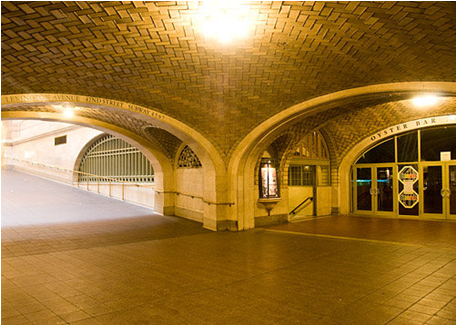
 The whispering gallery in Grand Central

In an underpass below Grand Central station, the arched walls allow the sound travel across the domed ceiling allowing two people to hear each other whisper when they stand at diagonal arches [2]. 
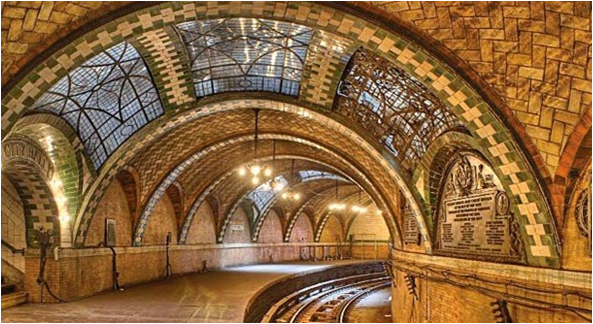
The old City Hall station
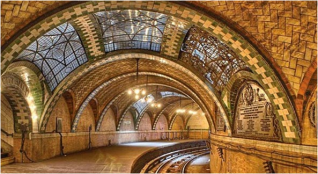
The City Hall subway stop on the 6 line closed in 1945 as it could not be modernized. We can sneak a glimpse of this station if we stay on the 6 train towards downtown after the last stop, as it passes through the station when it loops around to the uptown platform [2].

The three major types of artworks on subway
The cultural center of the western world, the big apple, New York City has been harboring millions of artists and various forms of artworks for many years. The art of NYC is like an ocean and in this book, we can only try to understand couple of drops of salty water from that ocean. We focus on three of the earliest forms of art here – painting, sculpture and music.  
Artwork: City Glow
Chiho Aoshima (2005)
Line: BMT Broadway Line
Location: 14th Street/Union Square 
Photo by: Robbie Rosenfeld [3] 

Artwork: Trains of Thought
Gardner/Heller.
Line: IND 6th Avenue Line
Location: Grand Street 
Photo by: Robbie Rosenfeld [3]  
The convoluted history of Graffiti art
In 1974, NYC was a city in crisis. Abe Beame, cut the city’s budget exceptionally to overcome the bankruptcy. But because of this a lot of school teachers, police officers, subway staffs lost their jobs. There were no outlets for the New Yorkers to protest against all the corruption. So, the city became their outlet, their canvas, their audience!
  First, someone just wrote his name, then someone else noticed it and added on to that. Soon, there were “letters going in front of letters, coming back through a letter, behind a letter, going across a letter… the subways became our playground”, as the subway artist Riff170 told in an interview to BBC [5].  That’s how graffiti art turned into an explosion, a movement.
  Graffiti writers came from all races – African American, Puerto Rican, Dominican, Cuban, Jewish, Asian etc. In 1977, there was huge power cut leading to blackout, loots and riots in the city. Abe Beame was replaced by Ed Koch who was determined to clean up the city. In 1983, David Gunn was hired as the president of NYC transit authority who launched a campaign to banish graffiti. Trains were taken out of service, cleaned as soon as any graffiti was spotted, carriages were protected at night behind the razor wire and the city banned selling spray cans to minors. In 1984, 80% of carriages were graffiti free. In 1989, MTA celebrated a graffiti free subway network.

TRACY 168, who began writing graffiti in the late sixties and invented wild style in the mid-seventies, painted this train in two minutes in 1974. Afterward, he added ink and whiteout to the photo [8].  

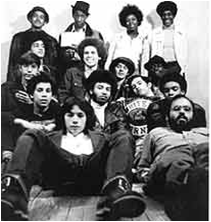
The United Graffiti Artists in 1973. From left, first row: COCO 144 and Hugo Martinez; second row: Rican 619, LEE 163, and Nova 1; third row: Rick 2, Ray-B 954, Cano 1, SJK 171, Snake 1, and Stay-High 149; fourth row (standing): Stitch I, Phase 2, Charmin 65, Bug 170 [8].

Painting

Losing my marbles
This glass mosaic masterpiece stretches across a 32-foot wall and two neighboring side walls in the 42nd St-Port Authority Bus Terminal station. Created by Lisa Dinhofer in 2003, it depicts a variety of toy marbles intended to stimulate the mind through illusions that manipulate physical perception [6].

Time square mural
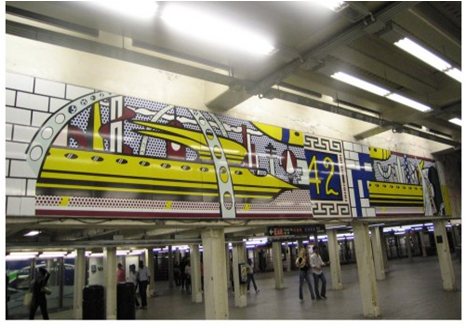
This brightly colored masterpiece stretches 6-feet high and 53-feet long inside the entrance of 42nd Street and Broadway in the Time Square subway station.  Created by Roy Lichtenstein in 2002, the mural celebrates the history of New York City transit by featuring visionary images of masonry, machines and modernism [6].

Masstransiscope
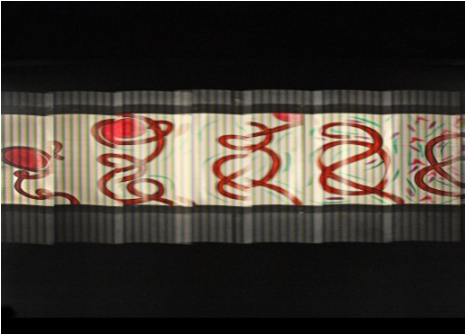
This animated piece of artwork lines the walls of the acant Myrtle Ave station on the B/Q lines and can be seen from Manhattan-bound express trains as they depart from the DeKalb station platform. Created by Bill Brand in 1980, this mural was inspired by a zoetrope and consists of 228 panels that come alive to create a moving image we pass by on the train [6].

Sculpture

Life underground
These pint-sized people are scattered about the floors and strewn along the railings of the 14th Street subway station at 14th St and Eighth Avenue. Created by Tom Otterness in 2001, the cartoonish bronze sculptures depict various scenes that comically poke fun at notions of criminality and corruption in New York City [7].

Hive
This overhead art installation can be found on the ceiling of the Bleecker Street subway station underneath the streets of Soho. Created by Leo Villareal in 2012, this work of art resembles hexagonal honeycomb patterns of moving neon-colored lights that aim to explore the human brain’s compulsion to identify patterns and establish meaning. [6].

A gathering
These little bronze birds can be found sitting atop the metal railings along the mezzanine of the Canal St subway station in Chinatown. Created by Walter Martin and Paloma Muñoz in 2001, this installation features more than 180 sculptures of crows, grackles and blackbirds perched in groups to highlight the social similarities that exist between people and birds.[6].

Music
A selection of 60 soloists and groups performed in Grand Central Terminal on May 13, 2014 during the MTA’s 27th annual auditions for its Music Under New York program. The auditions were held to add new talent to the program, which is administered by MTA Arts for Transit & Urban Design (AFT) and presents more than 7,500 performances annually in the MTA’s subways and railroads. Photo: MTA Arts For Transit / Rob Wilson [9]. A video clip of 2012 Music under New York is available on youtube [10].

Epilogue
Year: Unknown
Place: Midtown Manhattan, NY, NY
Time: 5 PM
A group of tourists are waiting for the tickets at the Museum of Modern Art with their hands tucked in their pockets. They all are sweating with excitement! They know tonight they are visiting a world-class collection of a modern art movement from 70’s and 80’s. The long line moves. The tourists finally enter the galleries. They take their hands out. Each one of them is holding a camera. They start taking pictures. They need to be fast! The museum will only be open till 8 PM tonight! This whole gallery is dedicated to the graffiti art of New York City. They take pictures of graffiti done by Dondi, Lady Pink, Zephyr, Julio 204, Friendly Freddie, Moses 147, Snake 131 and many more. Finally, a museum docent politely reminds them that the museum will close in 30 minutes. The tourists hurry up. They chatter excitedly in a foreign language among themselves and walk towards the exit sign. One of them pose and take picture of herself. The museum staff smiles and mutters “Tourists!”. These tourists flew from another continent to watch the art created by the teenager artists of 70’s who were once referred to as “Vandals”!

Bibliography
1. New York City Subway
2. 18 hidden secrets in NYC by Kaylin Pound
4. Music Under New York (MUNY)
5. Great Art? The graffiti of the New York subway By Chris Summers
6. 8 Amazing Art Installations in NYC’s Subway Stations by Kaylin Pound
7. Life underground
8. Graffiti in its own words by Dimitri Ehrlich and Gregor Ehrlich
9. 2014 Music under New York auditions
10. 2012 Music under New York auditions
NYC dream: Biomedical research

I have been writing this NYC dream blog for past couple of years now. I have written about my experiences in exploring the artistic and social side of New York City. But, I have been very cryptic about the scientific side of my favorite city. Last year, in one post I have mentioned that NYC is the second largest research grant receiving city in USA. This year, last month, I gave a hint that I have been working on some cancer-art collaboration projects. But, what’s really going on with my hardcore biomedical research? I think it is time to poke a hole in the shell of my INTJ persona and push in some of my ESFP persona in it.

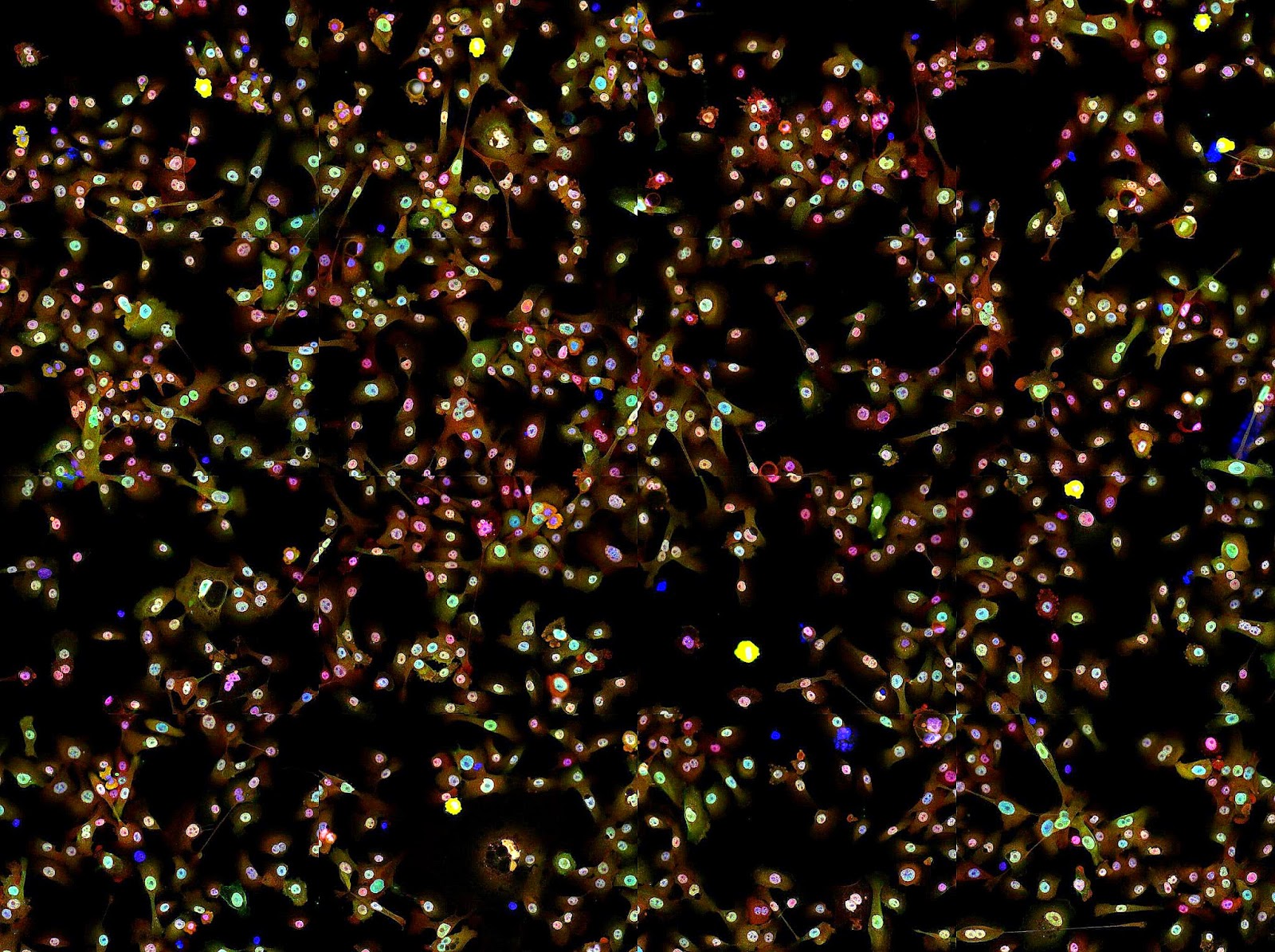
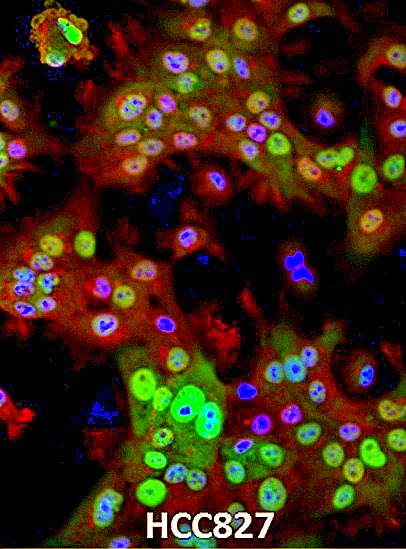
The main focus of my research has been variability within and among tumor cells. It is important to understand the extent of the predictability of this variability for its consequence on personalized cures for cancer. There are certain well known genes whose alterations cause cancer. These are called as oncogenes (‘onco’ meaning ‘cancer’). I have been studying extensively the connection between these oncogenes and cellular signaling alterations in lung cancer.
In recent years, couple of terminologies flooded the literature describing research findings in cancer. For example, systems biology and heterogeneity. The study of complex systems is not new in mathematics and physics. But until the first decade of this century, biologists focused mostly on reductionist approaches to understand every little detail of the molecular mechanism of cells. However, it was evident while understanding a complex diseased cell (e.g. cancer cell), we may need to study it as a whole. The idea is that the whole is bigger than the sum of its parts. It became more essential as the studies on tumor microenvironment provided evidences on the importance considering tumor cells along with their stromal microenvironment. Unfortunately, the term systems biology has been overused in literature for past few years. Nonetheless, the cancer biologists understand the importance of system-level view of cancer. Hence, in recent years, animal model systems harboring patient derived tumor tissues gained more popularity than two dimensional cell line model systems.

As we have progressed towards more complicated model systems the second term that I mentioned became more and more daunting. Heterogeneity! It means the tumor cells are not only different from one patient to another (inter-tumor heterogeneity), but they can also be different even within one patient’s tumor (intra-tumor heterogeneity). Now, imagine a situation, where a patient has more than one type of tumor cells in his/her body. A single needle biopsy from one region of the tumor may diagnose only one type of cell. If a therapy is designed based on this diagnosis, the undiagnosed cells may escape the therapy causing relapse of tumor. There have been a lot of research efforts to understand the origin and extent of this heterogeneity in cancer.  

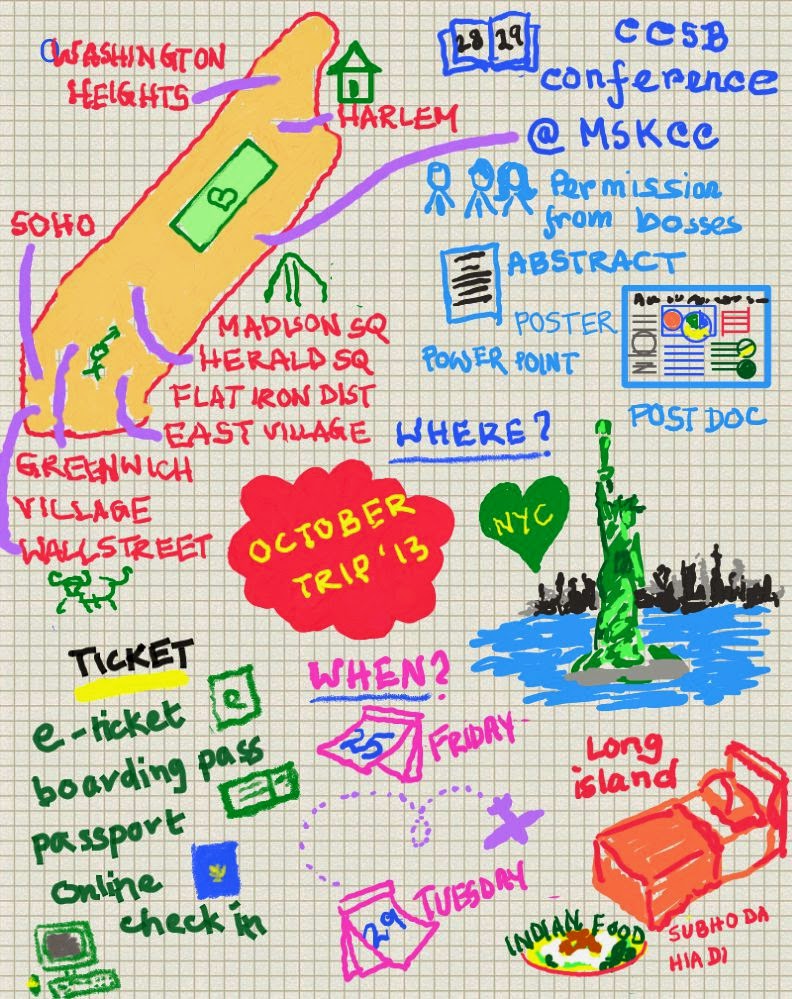
There have also been specific scientific conferences addressing systems biology and heterogeneity of cancer. One such meeting is organized by the Center for Cancer Systems Biology at Memorial Sloan-Kettering Cancer Center (MSKCC) at NYC. MSKCC is the second largest cancer research facility in USA (after MD Anderson Cancer Center at Texas). Hence, when I found out about this meeting, I immediately wanted to go. They had couple of travel fellowships to encourage attendance of PhD students and postdoc in this meeting. They call this fellowship as the young scientist award. I didn’t complain as it sounded better than a travel award. The review committee liked my abstract and I was one of the two awardees last year. As part of this travel award the awardee needs to deliver a short talk on his/her research. I prepared my talk well. The interdisciplinary attendees of the meeting liked my talk. That was a fascinating experience for me.
It is good to be appreciated and recognized for the hard work that we researchers put in everyday in the lab. In addition, it also opened new doors and windows in knowing intelligent scientists from various aspects of cancer research.
The question that interests me now is – is there a way to reeducate these cancer cells about the fact that the host body would be unable to contain them beyond certain limits?

NYC dream: A bit of NYC elsewhere – a luminous evening at Duncanville

When I heard about the art show located at Cedar Hill, I had no idea that not only I would be able to travel to Cedar Hill from Dallas, but also, at 9 PM of a chilly night, I would be in a Tundra truck with a friend I made on the previous night at the train station, and would be visiting my artist friend and her filmmaker husband’s house at Duncanville that connects with the main road with a narrow track completely surrounded by dark, large trees, in front of a creek full of raccoons, to make up for the time before going to watch the late night show of a sci-fi film that I have never heard of!
In the above sentence, I wanted to bring in two things that are absent from an average scientist’s life – spontaneity and long sentences! In general, scientists enjoy extensive planning and following their plans. I even have some scientist friends who get pretty uncomfortable and sometime, even upset, if things don’t go according to their thoroughly thought-about plans. As a result, they miss the fun of unplanned adventures. Secondly, scientists are forbidden from the creative freedom of writing any sentence that has more than 17 words. The reasoning behind this is that most fellow scientist readers, even if they are native English speakers, don’t have the patience to read long sentences. As unfortunate as this situation could be, I don’t have to stick with any of these two eccentricities while writing my blog (or living my life)!
Now coming back to how this luminous experience came into being for me. I first met Dr. Anne Gordon Perry and her husband Tim Perry at the “Literary night” at AT&T performing arts center. From the very first day, Anne and I became friends. After hearing about my art-science interests, she invited me to audit her humanities class at the Art Institute at Dallas. This was an evening class and was perfect for me as it didn’t clash with my day work schedule in the lab. As part of the class, we learnt various movements of art throughout the history, important terminologies for all forms of art ranging from drawing, painting, photography, sculpture, architecture, music, literature, cinema, theatre and dance! We took field trips to Dallas museum of art, Nasher sculpture center and the Pocket sandwich theatre. We read interesting poetry and fictions, and watched and discussed very unique documentary and fiction films. I have never been to a class of 40 students each one with good handwriting! One day, in the humanities class, Anne told us about an art show where she was taking part by displaying some of her fused glass works. Unfortunately, this show was in Cedar Hill where I could not commute via public transport from Dallas. But something interesting happened that night, which not only allowed me to travel to Cedar Hill but also have a great experience. 

That night, after the class I was waiting for the light rail at the station. I saw another student from the humanities class. I didn’t remember his name. He was a tall, white man, with long brown hair and a smiling face. I went ahead and started a conversation. His name was Brad. I found out that we were waiting for the same train. We spoke about my work at the lab and his work at the studio. During the small chat, my portrait painter identity kicked in and I noticed he had a sharp, long, Caucasian nose, dreamy eyes and thin lips. He said that he was going to the art show next day and would be able to give me a ride as my apartment was on his way. So, there was my new friend and my ride to the art show.

We reached the art show in Brad’s Tundra truck at around 8 PM. Anne was surprised and delighted to see us. We met with Tim, Anne’s glass work teacher, her friends, fellow artists and enjoyed a variety of artworks at the show. Then suddenly, Anne came up with the plan of inviting us to join her and Tim to watch “Interstellar”. I had no idea what it was – another art show, a sculpture, a musical or dance performance, or a film! But, I figured if two world traveler filmmakers and artists like Tim and Anne are interested in watching something, it must be something good. Fortunately, Brad was excited to watch it too. We were also joined by another student from the art institute – Mike. As this “Interstellar” started late at night we had some time to spare at Anne and Tim’s house at Duncanville. On our way to their house, Brad filled me in that Interstellar was a sci-fi film. Following Tim and Anne’s car we reached their house.

We were greeted by two very stranger-friendly cats. The house showed that Tim and Anne have traveled to so many places around the world. The whole house was full with souvenirs and relics and artworks from many countries, religions and cultures! Tim showed us his drone that he used to take the overhead shots in his films. We watched a short silent documentary film that was shot outside the Bahai temple at Chicago with four segments depicting four seasons – winter, spring, summer and fall.

In the end, fed with crackers and hummus, warmed with almond tea, having taken a tour in Anne’s chaotic and creative studio, holding three stories written by Anne and a dvd of the Bahai film made by Tim and Anne called “Luminous journey”, I left with Brad to follow Anne, Tim and Mike to the theater playing Interstellar.

The film was good. But for me the interesting experience was something else. After the last scene of the film ended, the screen started showing the credits. Generally, everyone starts to get up and leaves during this time. But, Tim, Anne, Brad and Mike, all of them sat through the whole credit very respectfully and religiously. I realized people who are connected with the filmmaking process, have interests in understanding and knowing the process of making of the film as well as the end product. Anne and Tim kept pointing at the names of the people in the crew that were known to them. Brad and Mike were silent, but I could see that they were paying attention to the names of those people. After the film, we came outside, said bye to everyone. I hopped into Brad’s car. He dropped me at my apartment at 2:30 AM.
It was truly an illuminating experience!

NYC dream: how much space part 3 – to loft or not to loft!

NYC apartments can be eccentric; full of strange angles, teeny tiny surface area, sometime unusually high ceiling, with big windows or little skylights. When I first heard the phrase “think vertical”, I have thought about bookcases, dividers, folded tables, cabinets, floating racks, wall lamps, magnetic spice containers, wine bottle hangers and even two storied closets. Only recently it occurred to me that I have missed the elephant in the room – the bed! The full bed (queen if you are lucky) takes the maximum amount of horizontal area in a teeny tiny studio apartment!
I was never a murphy-bed lover. After working at minimum two jobs (one pays your bills, the other is simply for fun), when I enter my apartment, there is nothing more welcoming than the sight of a cozy, comfortable bed with personalized pillows and a sexy painting hanging over the headboard. A murphy bed never does that unless you leave it unfolded, in which case the purpose of murphy-bed is lost. In addition, my apartment is my “sanctum sanctorum” and apart from my occasional dates, I don’t generally entertain a large group of people. In addition, if you are renting, not many owners would allow you to fix a murphy-bed on the wall. So, what are my other options?
Loft bed! Yes, if you have high ceilings, you can choose to raise the largest furniture you own and then utilize the space underneath for a table, couch, or both, a small walk-in closet, a reading nook, or even a dorm refrigerator or microwave.  However, there are couple of challenges that you need to overcome before being comfy in your lofty bed.
How to get down from the loft bed in the middle of the night with sleepy head and avoid breaking your neck by falling down the tiny staircase? The answer is- create your own custom staircase by the wall with storage boxes underneath. The cover of those storage boxes can be painted canvas (if you are into fine art like me) hanged with little hooks and nails. Also, keep a glass of water on the little wall rack by the bed.
How to not bump your head in the bedframe while using the area underneath? I think the answer is – practice makes the man (or the woman) perfect! First sit down and then slide in your couch. Try to find very low day beds which can serve multiple purposes. With couple of decorative side and back throw pillows, this will serve as a couch or day bed and can be used as a guest bed when required. Put the day bed longitudinally with the length of the loft bed, so that a part of the day bed sticks out. That will make the practice of sitting first and sliding in second- easier.

How to cope with panic attacks in the middle of the night waking up and seeing the ceiling so close to your nose (if you are claustrophobic)? Immediately, turn your head sideways and have the bird’s eye view of your beautifully decorated studio apartment. Breathe, then slowly come down the custom staircase. Relax. The sky is not falling down yet!

NYC dream: an itinerary to explore the multifaceted neighborhoods

This trip is actually a year old. Last year, when I went to NYC to receive the Young Scientist Award from Center for Cancer Systems Biology at Memorial Sloan-Kettering Cancer Center, I stayed at my cousin’s place in Long Island. In addition to attending the conference and spending time with the family, I made sure that I practice how to get lost in NYC. However, it is not a good idea to get lost a lot, if you want to cover a lot of neighborhoods in one single day. Hence, this itinerary was made from careful planning and research.

1. At 7 AM, Leave for Rockville center station, take Babylon towards Penn station at 7:27 AM. Reach Penn station at 8:15 AM.
2. Walk to 34th St. – Herald sq. Station. Look for Horace Greeley’s statue. Take R towards Bay ridge or N towards Coney Island to 23rdst. station.  Flat iron building. Walk to Madison Square Park.
3. Walk to Museum of sex at 233 5th ave at E 27th st. The museum opens at 10 AM.
4. At 12 PM, walk to 28thst station. Take R towards Bay Ridge to 8th st – NYU station or 6 towards Brooklyn bridge-city hall to Astor – PI station. Walk to the Trash clothing store at 4thst Marks PI.
5. At 1 PM, look for food trucks nearby in YELP.
6. Walk to Sclupture Alamo (The cube) at 57 Astor PI.
7. Walk to Union square-14thst.  George Washington and Abraham Lincoln statue in Union square park. Look for Metronome and Passage time.

8. At 2:30 PM, from 14 st – union sq station, take 4 towards Crown hits – Utica av or 5 towards bowling green to Bowling green station. Walk to Charging bull statue at 1 Bowling Green.

9. At 3:15 PM, walk to South Ferry station; take 1 towards Van Cortlandt Park to 116 st – Columbia University station. Walk to Riverside Church at 490 Riverside Dr.
10. At 5 PM, walk to 116st – Columbia University station, take 1 towards South Ferry to 59 st – Columbus circle; Eat from food trucks.
11. At 5:45 PM, walk to 59 st – Columbus circle station, take A towards Ozone park – Lefferts Blvd or C towards Euclid av, High st station. Walk to Brooklyn Bridge Park: Pier 1 at Old Fulton st.

12. At 7 PM, from High st station, take A towards Inwood – 207 St, or C towards 168 st, to 34th st – Penn Station. Walk to Eagle bar or Six Lounge for a drink or two.
13. Walk back to Penn station. Take Babylon towards Balylon to Rockville center.
You can imagine, by the end of the day, how tired yet fulfilled I was!

NYC dream: Creating my own little NYC elsewhere

My NYC dream is getting delayed from turning into a reality. After a lot of time, not writing anything, I thought why don’t I make my little NYC in Dallas itself? I have made some reasonable contacts in art – science collaboration field, read a lot of sci-artists’ biography, am involved in a cancer – art collaboration project. I can write about them. I can create a small part of my NYC dream with them anywhere.

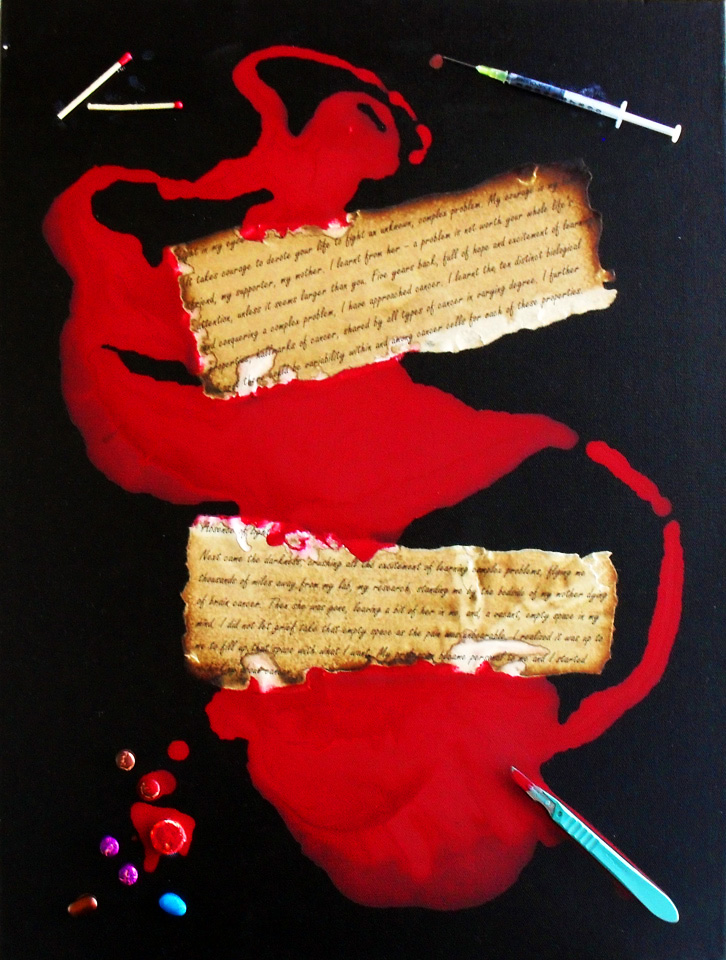
I will start with a literary art piece that I have written as part of the personal statement for our cancer – art project. This non fiction named “Cancer” was one of the winners in the “creative non fiction” category of literary art competition organized by the Business council of art of North Texas. It addresses a part of my emotional response to cancer. Later I did two mixed media pieces on this.

Cancer


“With the light in my eyes,
I have seen beyond my sight,
Today I shall see into my heart,
In the absence of that light”


– An attempt to translate from Rabindranath Tagore


Beyond my sight

I have seen cancer as I walk to my lab, in patients waiting in the radiation therapy wing, wrapping their bald heads in pieces of cloth and wrapping their hands around their loved ones. I have seen cancer as I look under the microscope, at the cell lines derived from the patients, to aid research for personalized therapy. I have seen cancer as a complex disease, a combination of multiple diseases, where the healthy cells from our own body turn into our enemy. How do we fight an enemy who is our own?

Light in my eyes

It takes courage to devote your life to fight an unknown, complex problem. My courage is my best friend, my supporter, my mother. I learnt from her – a problem is not worth your whole life’s attention, unless it seems larger than you. Five years back, full of hope and excitement of learning and conquering a complex problem, I have approached cancer. I learnt the ten distinct biological properties, hallmarks of cancer, shared by all types of cancer in varying degree. I further learnt there could be variability within and among cancer cells for each of these properties.

Absence of light

Next came the darkness, crushing all the excitement of learning complex problems, flying me thousands of miles away from my lab, my research, standing me by the bedside of my mother dying of brain cancer. Then she was gone, leaving a bit of her in me, and, a vacant, empty space in my mind. I did not let grief take that empty space as the pain was unbearable. I realized it was up to me to fill up that space with what I want. My profession became personal to me and I started rethinking about cancer.

See into my heart

Today I see cancer as manifestation of life itself, trying to survive a stressful condition, inside the body’s harsh environment. Is there a way to reeducate these cancer cells, so that they understand the host body would be unable to contain them and they would eventually cease to exist? The key may be hidden in the multidimensional complex experimental data. We are unable to find it now, as we see what we know we see. Visualizing the data represented in a different media may help us. Hopefully, this alternative way of “seeing” will guide me towards “how to see” in the empty space between God and Adam’s fingers.