I grew up in a place where nothing was guaranteed.
We didn’t always call it scarcity. It was simply the engineering of daily life — how far a lunchbox could travel, how long a fabric could endure, how a roof could mean gratitude and uncertainty in the same breath. Safety was a rumor adults tried to make believable. I learned to notice what held and what trembled. I learned to look twice.
That is where my way of seeing began. Maybe that is where a scientist is born. Maybe that is where an artist is born too.
I loved two ways of seeing. One wanted proof. The other wanted meaning. For years I thought they would diverge, like railway tracks leaving a crowded station.
Cancer made sure it didn’t.
I came to the United States and earned my PhD, pursuing cancer as both puzzle and adversary. In the laboratory, the world could be persuaded to answer. There was discipline in it, and aesthetics — the quiet thrill of a signal emerging from noise. A future was beginning to assemble itself, piece by deliberate piece.
And then time changed. Hours refused to move in a straight line. The life I was constructing — ambitions, plans, the careful architecture of becoming — loosened its grip. Cancer has a way of doing that: it does not knock; it rearranges gravity.
When my mother was diagnosed with a very aggressive cancer, I felt carried by a force I could neither measure nor resist, flung out of momentum and into an older knowledge of uncertainty. The ground I trusted remembered how easily it could give way.
Then time thickened and slowed further. What I knew how to calculate remained true. But it was no longer enough. Mechanism could not contain mourning. No p-value could quiet a hospice room after the machines stopped. I needed a vocabulary with edges wide enough for love, anger, memory, and the unfinished nature of goodbye.
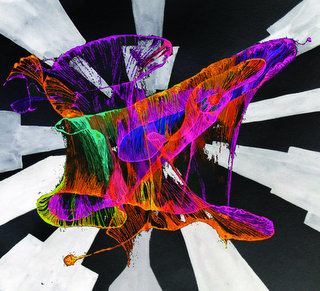
So I spoke with art. The work that grew from that turn — paintings, collaborations, experiments in translation — lives at dhrudeb.com, an evolving record of the questions I am still trying to ask.
Art let me remain with uncertainty without demanding closure. It stretched my tolerance for ambiguity. It taught me to circle a question, to feel its weather, to imagine beyond the frame. And slowly, without announcement, it began to change my science. I asked broader things. I listened differently. I began to understand that empathy is not separate from innovation — it is one of its engines.
I built a life in New York City, where urgency hums in every direction. I serve in organizations helping steer research toward futures where loss might arrive later — or not at all. I founded a network of researchers, patients, caregivers, artists and musicians, because I have seen what becomes possible when we allow our intellectual lives to remain porous to our emotional ones.
I once believed cancer only took from me.
I understand now that it also revealed a responsibility — to widen the culture of science, to insist that imagination belongs in the lab, to help build communities where grief can transform into momentum for someone else’s survival.
I still live in the space between the microscope and the canvas.
In the hour when pigment forgets itself and becomes radiance, a presence gathers — not absence, not memory, something still arriving.

 Science, art and lifestyle